
An Experimental Study of Combustion Characteristics and Thermal Efficiency of LPG using an Industrial Burner

Authors

  • Suwit Suksaeng Department of Mechanical Engineering, Faculty of Engineering, Prince of Songkla University, Songkhla, 90110, Thailand
  • Arkom Palamanit Biomass Energy and Sustainable Technology (BEST) Research Center, Energy Technology Program, Department of Interdisciplinary Engineering, Faculty of Engineering, Prince of Songkla University, Hat Yai 90110, Songkhla, Thailand
  • Dhinesh Balasubramanian Department of Mechanical Engineering, Mepco Schlenk Engineering College, Sivakasi, Tamilnadu, India
  • Anant Karegaonkar Forbes Marshall Pvt Ltd, PB29, Mumbai Pune Road, Kasarwadi, Pune 411034, India
  • Makatar Wae-hayee Biomass Energy and Sustainable Technology (BEST) Research Center, Faculty of Engineering, Prince of Songkla University, Songkhla, 90110, Thailand

DOI:

https://doi.org/10.37934/sej.7.1.4856

Keywords:

LPG, Combustion, Equivalence ratio, Flame, Flue gas, Thermal efficiency

Abstract

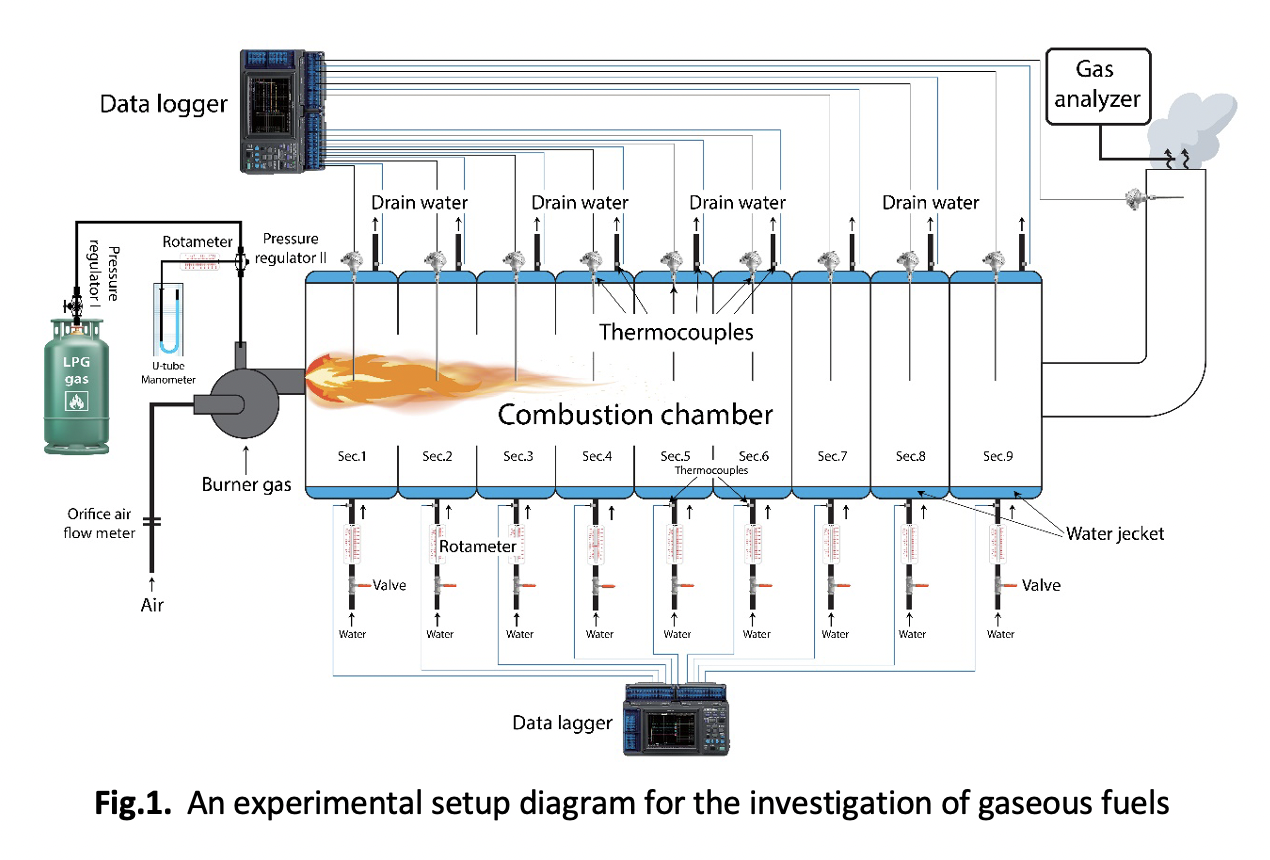
This research focuses on studying the combustion characteristics of LPG gas using an industrial gas burner, the NU-WAY model STG120/2 S1L 95 from Sweden. A combustion chamber has a cylindrical shape with a length of 185 cm, an internal diameter of 40 cm. Water jackets with a thickness of 5 cm were assembled covering the combustion chamber. To evaluate the thermal efficiency of the system, temperature inlet and outlet of cooling water were measured under steady state. Properties of exhaust gas were measured using flue gas analyzer (Testo350). The results show that the equivalence ratio (ER) significantly affects the flame characteristics, flame temperature, and thermal efficiency. At ER=1, the flame is the longest and light blue, indicating complete combustion and the highest thermal efficiency. At ER=1.1, the flame remains long but has a lower temperature due to insufficient air, resulting in incomplete combustion and reduced energy release. This study helps understand the flame characteristics and combustion efficiency under different conditions, which is crucial for improving efficiency and reducing harmful gas emissions in industrial processes. Additionally, the findings can be applied in the design and control of industrial thermal equipment.

Author Biography

Makatar Wae-hayee, Biomass Energy and Sustainable Technology (BEST) Research Center, Faculty of Engineering, Prince of Songkla University, Songkhla, 90110, Thailand

Hamiyee.y@gmail.com

Downloads

Published

2024-12-05

Issue

Section

Articles