
Coupled Thermochemical Mechanism in Plasma Co-Gasification of Empty Fruit Bunches and Plastic Waste: Evaluation of Syngas and Char Microstructural Evolution

Authors

  • Dashvenan Letchumanan Faculty of Mechanical and Manufacturing Engineering, Universiti Tun Hussein Onn Malaysia (UTHM), 86400 Parit Raja, Batu Pahat, Johor, Malaysia
  • Afiq Asmawi Faculty of Mechanical and Manufacturing Engineering, Universiti Tun Hussein Onn Malaysia (UTHM), 86400 Parit Raja, Batu Pahat, Johor, Malaysia
  • Izuan Amin Ishak Department of Mechanical Engineering Technology, Faculty of Engineering Technology, Universiti Tun Hussein Onn Malaysia (UTHM) Higher Education Hub Pagoh, KM 1, Jalan Panchor, 84600 Panchor, Johor, Malaysia
  • Rais Hanizam Madon Faculty of Mechanical and Manufacturing Engineering, Universiti Tun Hussein Onn Malaysia (UTHM), 86400 Parit Raja, Batu Pahat, Johor, Malaysia
  • Nik Normunira Mat Hassan Faculty of Mechanical Engineering, Kompleks Kejuruteraan Tuanku Abdul Halim Mu'adzam Shah, Universiti Teknologi MARA, 40450 Shah Alam, Selangor, Malaysia
  • Yos Nofendri Fakultas Teknologi Industri & Informatika, Universitas Muhammadiyah Prof DR Hamka, J. Tanah Merdeka No. 6, RT. 10/ RW. 5, Rambutan, Kec. Ciracas, Kota Jakarta Timur, Daerah Khusus Ibukota Jakarta 13830, Indonesia
  • Nor Afzanizam Samiran Department of Mechanical Engineering Technology, Faculty of Engineering Technology, Universiti Tun Hussein Onn Malaysia (UTHM) Higher Education Hub Pagoh, KM 1, Jalan Panchor, 84600 Panchor, Johor, Malaysia

DOI:

https://doi.org/10.37934/sej.16.1.1633

Keywords:

Plasma co-gasification, Hydrogen-rich syngas, Oil palm biomass, Waste-to-energy (WtE), Char characterization, Polymer decomposition

Abstract

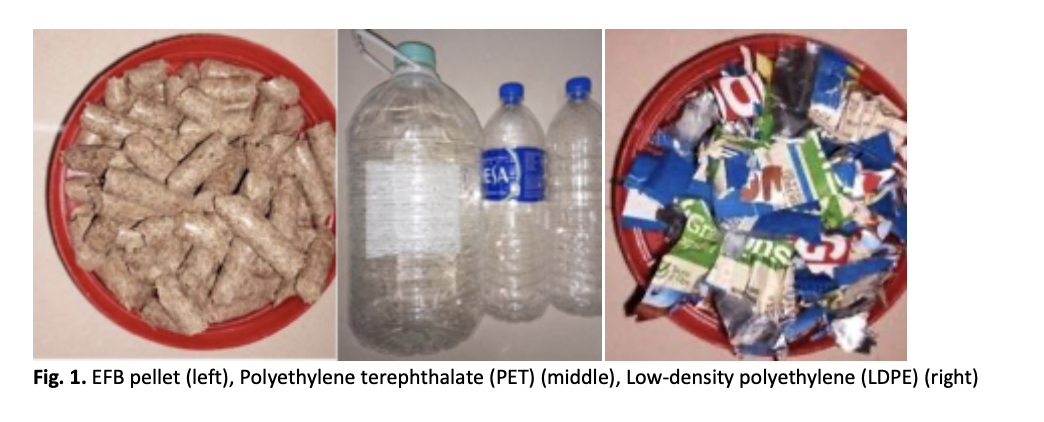
The increase in the production of municipal solid waste (MSW) and oil palm biomass in Malaysia needs to be managed using more advanced thermochemical solutions to overcome the shortcomings of existing conventional gasification technologies such as high tar production, low conversion efficiency, and unstable syngas quality. This study was conducted to evaluate the performance of a thermal arc plasma co-gasification process using a combination of oil palm empty bunches (EFB) and plastic waste, specifically low-density polyethylene (LDPE) and polyethylene terephthalate (PET) as feedstock. The experiments were conducted in triplicates to ensure data reliability, using a 9 kW plasma integrated downdraft reactor operating at atmospheric pressure with a reaction time of 10–12 minutes at 90/10, 80/20, and 70/30 blend ratios. Gas chromatography analysis revealed that increasing the plastic fraction significantly enhanced hydrogen production (H2), with the EFB-LDPE blend reaching a maximum concentration of 8.83% at the 70/30 ratio, indicating an improvement in syngas quality. The optimum energy yield was obtained at the 80/20 blend ratio, producing a peak high calorific value (HHV) of 3.72 MJ/kg for the LDPE blend and 2.91 MJ/kg for the PET blend, demonstrating favourable energy recovery potential. Scanning Electron Microscopy (SEM) analysis using ImageJ software showed that the incorporation of LDPE increased the porous area to 18.05% with an average pore size of 55.29 µm², suggesting enhanced gas-solid interaction and improved char reactivity during the gasification process. In addition, Fourier Transform Infrared Spectroscopy (FTIR) analysis provided evidence at the molecular level regarding the ability of plasma to decompose complex polymer structures. For the EFB-PET char product, the appearance of peaks at 1014.93 cm⁻¹ and 1378.04 cm⁻¹ indicated the formation of ester bonds and partial decomposition of the polymer chain. For the EFB-LDPE sample, the detection of C=N stretching vibrations at 2332.52 cm⁻¹ and C-O-C ester vibrations at 1012.98 cm⁻¹ confirmed the existence of a structural recombination process and strong interactions between the biomass fraction and the polymer. Overall, these findings prove that plasma co-gasification can not only optimize syngas quality, but also assist in the complete transformation of waste into more stable char residue with the presence of distinctive functional groups.

Author Biographies

Dashvenan Letchumanan, Faculty of Mechanical and Manufacturing Engineering, Universiti Tun Hussein Onn Malaysia (UTHM), 86400 Parit Raja, Batu Pahat, Johor, Malaysia

shvendash26@gmail.com

Afiq Asmawi, Faculty of Mechanical and Manufacturing Engineering, Universiti Tun Hussein Onn Malaysia (UTHM), 86400 Parit Raja, Batu Pahat, Johor, Malaysia

mafiqasmawi@gmail.com

Izuan Amin Ishak, Department of Mechanical Engineering Technology, Faculty of Engineering Technology, Universiti Tun Hussein Onn Malaysia (UTHM) Higher Education Hub Pagoh, KM 1, Jalan Panchor, 84600 Panchor, Johor, Malaysia

Rais Hanizam Madon, Faculty of Mechanical and Manufacturing Engineering, Universiti Tun Hussein Onn Malaysia (UTHM), 86400 Parit Raja, Batu Pahat, Johor, Malaysia

Nik Normunira Mat Hassan, Faculty of Mechanical Engineering, Kompleks Kejuruteraan Tuanku Abdul Halim Mu'adzam Shah, Universiti Teknologi MARA, 40450 Shah Alam, Selangor, Malaysia

Yos Nofendri, Fakultas Teknologi Industri & Informatika, Universitas Muhammadiyah Prof DR Hamka, J. Tanah Merdeka No. 6, RT. 10/ RW. 5, Rambutan, Kec. Ciracas, Kota Jakarta Timur, Daerah Khusus Ibukota Jakarta 13830, Indonesia

Nor Afzanizam Samiran, Department of Mechanical Engineering Technology, Faculty of Engineering Technology, Universiti Tun Hussein Onn Malaysia (UTHM) Higher Education Hub Pagoh, KM 1, Jalan Panchor, 84600 Panchor, Johor, Malaysia

Downloads

Published

2026-09-09

Issue

Section

Articles