Production capacity forecasting model: A data approach in the apparel industry
DOI:
https://doi.org/10.37934/sej.16.1.3448Keywords:
Production capacity, clothing industry, customer order, forecasting model, machine learningAbstract
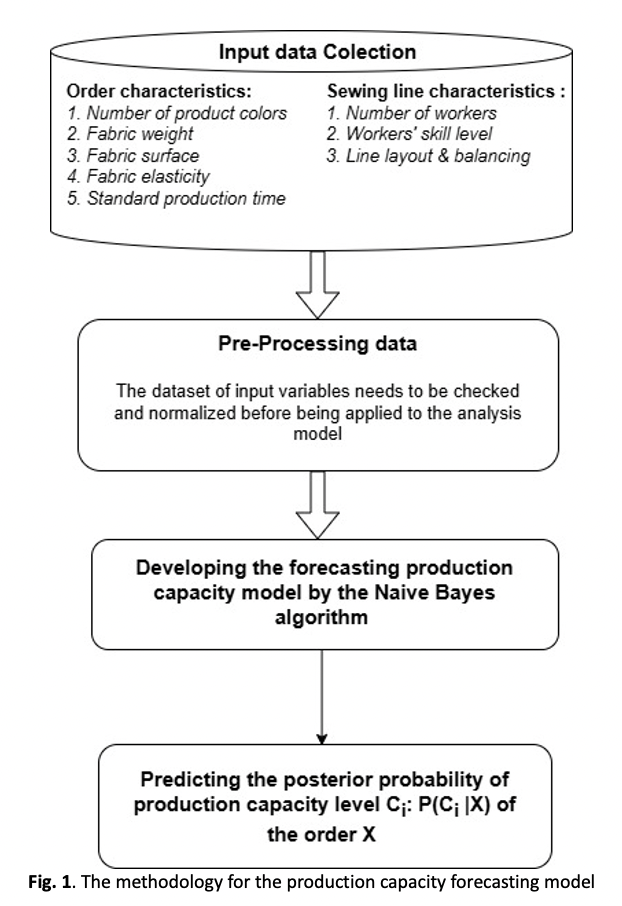
In the clothing industry, a sector facing increasingly stringent demands regarding productivity, costs, and delivery schedules, the application of machine learning to forecast production capacity has become an essential management requirement. This study focuses on developing a production capacity forecasting model by analyzing the interplay between clothing order characteristics and sewing line parameters. The Naive Bayes model provides a probabilistic framework for classifying expected production capacity into distinct levels; consequently, the model’s output offers a clear basis for planners to assess capacity-related risks and make informed decisions regarding resource allocation and line balancing. Specifically, the forecasting results can support decisions concerning workforce requirements, production scheduling, sewing line assignments, and delivery planning. The research also demonstrates the potential of machine learning as a decision-support tool, transforming historical production data into actionable insights to inform practical plans. These findings will enable fashion enterprises to optimize resources, meet rigorous customer demands, and mitigate risks throughout the production process.