

Solar Photovoltaic Adoption in East Java Non-Profit Organizations

Authors

  • Ely Siswanto Applied Marketing Management, Faculty of Vocational Studies, State University of Malang, Jl. Semarang No. 5, Malang, 65145, Indonesia
  • Achmad Hamdan Electronic Systems Engineering Technology, Faculty of Engineering, State University of Malang, Jl. Semarang No. 5, Malang, 65145, Indonesia
  • Lulu Nurul Istanti Department of Management, Faculty of Economics and Business, State University of Malang, Jl. Semarang No. 5, Malang, 65145, Indonesia
  • Shahir Akram Hassan Center for Islamic Development Management Studies, School of Social Sciences, Universiti Sains Malaysia, 11800 Gelugor, Penang, Malaysia

DOI:

https://doi.org/10.37934/sej.16.1.4964

Keywords:

solar photovoltaic, non-profit organizations, bibliometric review, East Java, meta-analysis, Monte Carlo simulation

Abstract

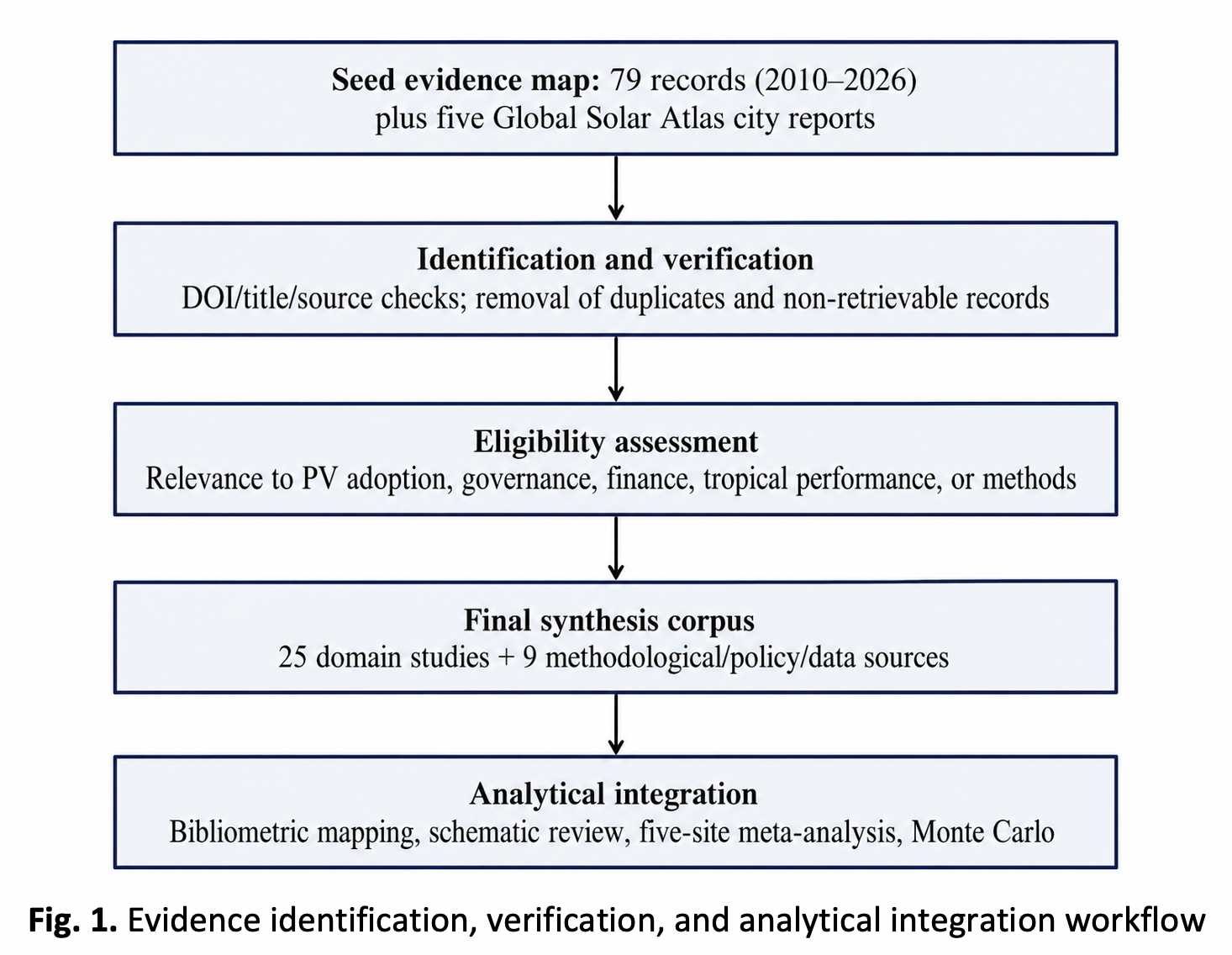
Non-profit organizations in East Java need dependable electricity for service continuity, daily operations, and cost control, yet face capital, regulatory, behavioral, and tropical-climate barriers to rooftop solar photovoltaic adoption. This study combines a focused literature review, bibliometric mapping of 25 verified domain studies selected from 79 unique Scopus records, a random-effects synthesis of five Global Solar Atlas locations, and a 50,000-iteration Monte Carlo model for a common 12 kWp system. The 25 studies met predefined adoption, finance/policy, governance/behavior, and tropical-performance criteria and passed metadata verification. Modeled annual output ranges from 17.231 to 18.227 MWh; pooled yield is 4.03 kWh/kWp/day (95% CI: 3.92–4.14). Median NPV is IDR 40.7–54.9 million, with a conditional positive-NPV probability of 86.4–92.5%. Sensitivity analysis identifies the discount rate, tariff escalation, capital cost, avoided electricity value, and self-consumption as the dominant drivers of NPV. The five-city results are screening evidence, not a representation of all tropical climates or roofs. A 30% grant or blended-finance contribution raises positive-NPV probability above 99.8% and reduces median payback to 5.8–6.2 years.

Author Biographies

Ely Siswanto, Applied Marketing Management, Faculty of Vocational Studies, State University of Malang, Jl. Semarang No. 5, Malang, 65145, Indonesia

ely.siswanto.fe@um.ac.id

Achmad Hamdan, Electronic Systems Engineering Technology, Faculty of Engineering, State University of Malang, Jl. Semarang No. 5, Malang, 65145, Indonesia

achmad.hamdan.ft@um.ac.id

Lulu Nurul Istanti, Department of Management, Faculty of Economics and Business, State University of Malang, Jl. Semarang No. 5, Malang, 65145, Indonesia

lulu.nurul.fe@um.ac.id

Shahir Akram Hassan, Center for Islamic Development Management Studies, School of Social Sciences, Universiti Sains Malaysia, 11800 Gelugor, Penang, Malaysia

shahirakram@usm.my

Downloads

Published

2026-09-09

Issue

Section

Articles