Synergistic Bio-Circular Renewable Energy Systems: Integrating Agricultural Waste-Derived Electrolytic Coolants for Next-Generation Photovoltaic Thermal (PV/T) Optimization in Tropical Regions
DOI:
https://doi.org/10.37934/sej.15.1.172198Keywords:
bio-circular economy, agricultural waste, electrolytic bio-coolant, photovoltaic/thermal system, physics-informed deep learning, Monte Carlo simulationAbstract
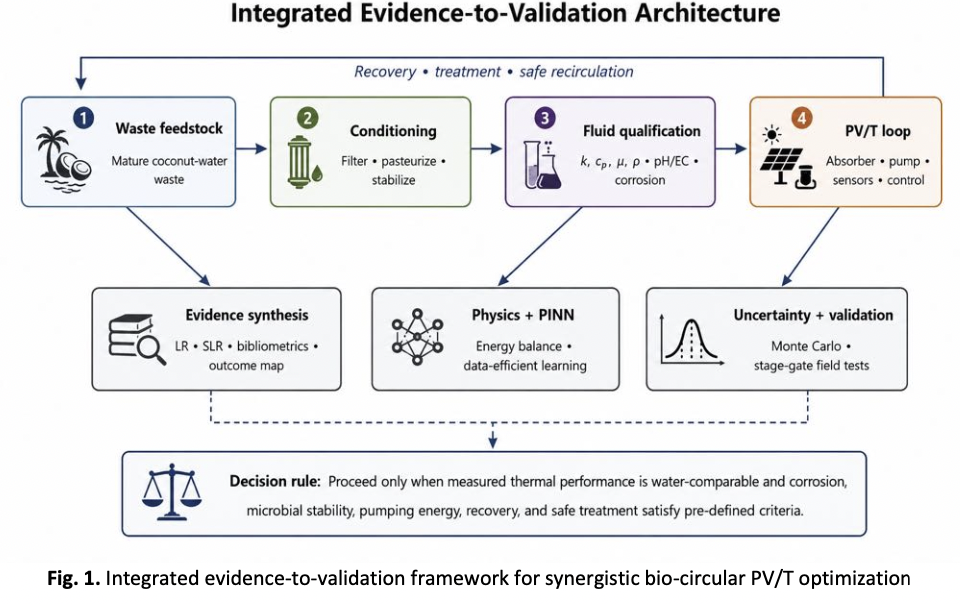
Tropical photovoltaic modules experience temperature-driven electrical losses, while large volumes of mature coconut water and other agricultural liquid residues remain underutilized. This study develops a bio-circular photovoltaic/thermal framework that treats a conditioned agricultural-waste liquid as a measurable engineering candidate rather than assuming that natural electrolytes inherently improve heat transfer. In this work, "stabilized bio-coolant" is an operational acceptance status: a traceable mature-coconut-water batch is screened and serially filtered, subjected to a validated thermal or membrane treatment, stored in an opaque closed system, and accepted only after 30-day microbial, pH, turbidity, viscosity, gas/phase-separation, and hydraulic-stability checks. A transparent evidence workflow combined literature review, systematic screening, bibliometric mapping, and quantitative outcome mapping of 32 validated publications. A reduced-order energy-balance model, a limited-data physics-informed neural network, a 50,000-run Monte Carlo simulation, and a side-by-side experimental protocol were then decision-coupled. At 1,000 W/m² and 20 g/s, the bio-coolant reduced module temperature by 11.89 °C and increased electrical power by 5.63% relative to the uncooled PV baseline. However, water remained the better coolant benchmark: total efficiency was 50.73% for the bio-coolant and 52.99% for water, a bio-coolant deficit of 2.26 percentage points. The physics-informed model achieved 0.21 °C RMSE and R² = 0.998, while uncertainty analysis yielded a median reduction of 7.14 °C and a 38.56% probability of meeting an 8 °C target. The coupled workflow generated two non-obvious findings: cooling efficacy relative to uncooled PV does not imply superiority to water, and weather, flow, and construction uncertainty can dominate modest fluid-property differences. The concept is therefore a conditional resource-substitution pathway, not a proven high-performance replacement for water; corrosion, microbial stability, pumping energy, and long-duration tropical field validation remain mandatory.