A Hybrid Framework Integrating Meta-Analytic Evidence, Physics-Informed Deep Learning, and Monte Carlo Simulation for Risk and Optimization of Green Hydrogen Production via Hybrid Renewable Systems
DOI:
https://doi.org/10.37934/sej.15.1.125148Keywords:
Green hydrogen, Hybrid renewable energy, Physics-informed deep learning, Monte Carlo simulation, Conditional Value-at-Risk, Meta-analysisAbstract
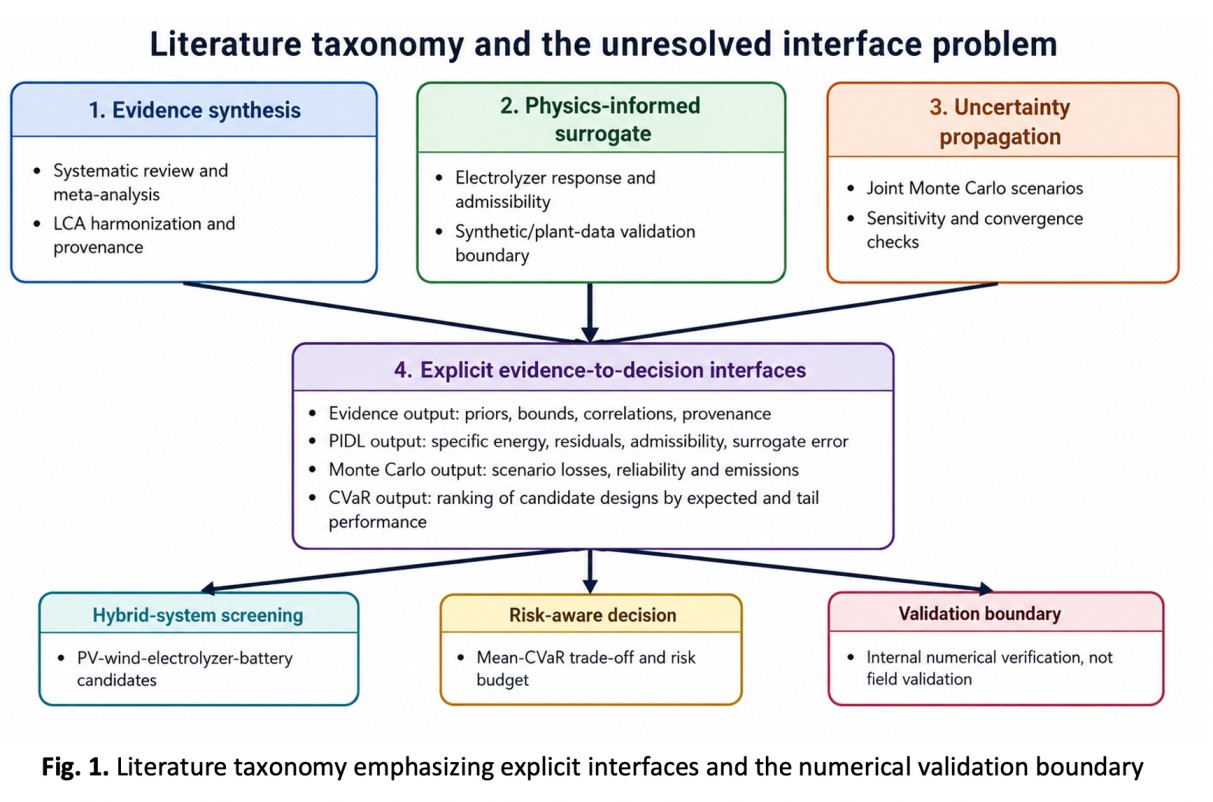
Green hydrogen supplied by variable solar and wind resources is exposed to coupled technical, economic, environmental, and operational uncertainty that deterministic optimization can conceal. This study develops a four-layer decision framework with explicit data contracts: structured evidence synthesis produces parameter priors, bounds, correlations, and provenance; a physics-informed deep-learning (PIDL) surrogate maps operating states to physically admissible electrolyzer-specific electricity consumption; Latin-hypercube Monte Carlo simulation propagates the joint priors through an hourly rule-based dispatch model; and Conditional Value-at-Risk (CVaR) ranks a predefined set of candidate designs by expected and tail cost. The numerical demonstration uses one synthetic renewable year, literature-derived cost distributions, and synthetic PIDL observations; it therefore verifies internal behavior rather than real-world or site-specific performance. Within this illustrative benchmark, PIDL reduced test RMSE from 0.70 to 0.21 kWh kg-1 and eliminated out-of-domain test predictions. Across 10,000 scenarios, the lowest-cost candidate in the tested set achieved a mean LCOH of USD 4.62 kg-1 and a 95% CVaR of USD 6.49 kg-1, compared with USD 5.08 and USD 7.16 kg-1 for the designated risk-neutral case. Financing costs, electrolyzer capital costs, and wind resource uncertainty dominated the variability. Because these costs remain above typical unabated fossil-hydrogen benchmarks, early projects would require a combination of de-risked finance, long-term offtake, demand creation, production support, and/or carbon-value instruments. The results do not include plant validation, battery aging, or explicit logistics for hydrogen storage, transport, and delivery.