Rate of Penetration Prediction in Highly Deviated Wells Using Two Machine Learning Techniques; An Application in The Mediterranean Basin
DOI:
https://doi.org/10.37934/araset.14.1.125138Keywords:
Artificial Neural Network, Random Forest, ROP Prediction, Mediterranean Basin, Machine LearningAbstract
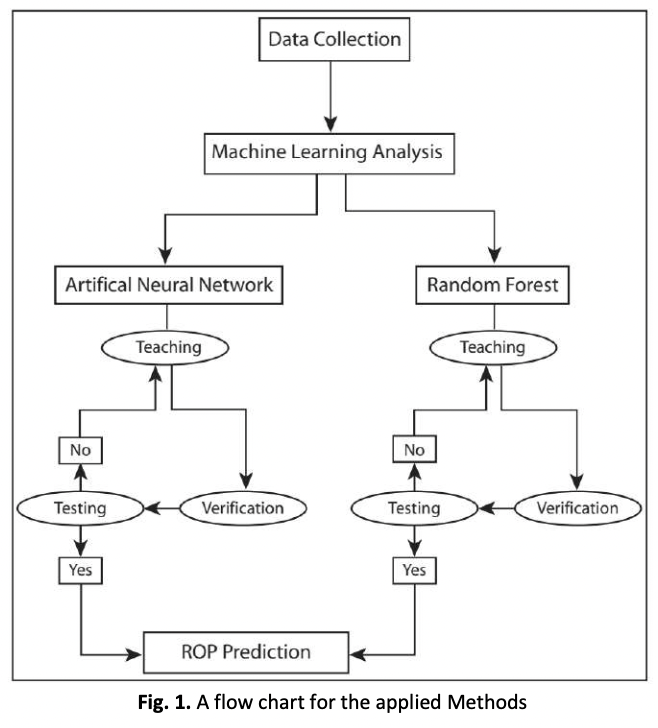
Highly deviated and extended reach wells became a popular practice to achieve maximum contact to oil and gas reservoirs and solve numerous production challenges. This study presents an efficient and accurate ROP prediction method that can be applied in highly deviated wells. To accomplish this, artificial neural network (ANN) and random forest (RF) are utilized to predict the rate of penetration in highly deviated wells in Egyptian fields located in the Mediterranean Sea. A data set with 6000 points of common drilling parameters are subdivided into training, validation and testing data. These data include true vertical depth (TVD), flow in, mud weight, hole size, weight on bit (WOB), hook load (HL), standpipe pressure (SPP), torque, rotational speed (RPM), inclination angle and lithology. Using these data, several ANNs (using MemBrain software and Python) and RFs are tested to help predicting ROP efficiently. Comparing the results of different trials to the real reported ROP using the mean square error, the RF models showed two folds improvement in errors (RF= 0.003112; Python ANN= 0.0076287; MemBrain ANN= 0.0080767). Furthermore, RF enables combining numerous parameters in a simple structure and coding compared to ANN technique. To present a real well plan, a random set of hypothetical data is generated, and RF is applied for ROP prediction and alternatively a sensitivity analysis is performed. Results indicated that the developed RF model provided an efficient tool for ROP prediction at low cost that enables adjusting drilling parameters for optimum drilling performance.