Stretchable Sensor-Based Glove for Hand Pose Recognition while Performing Activity of Daily Living (ADL) Tasks using Random Forest and K-Nearest Neighbors
DOI:
https://doi.org/10.37934/sej.14.1.117Keywords:
Stretchable sensor data glove, wearable sensors, ADL, Machine learning, TelerehabilitationAbstract
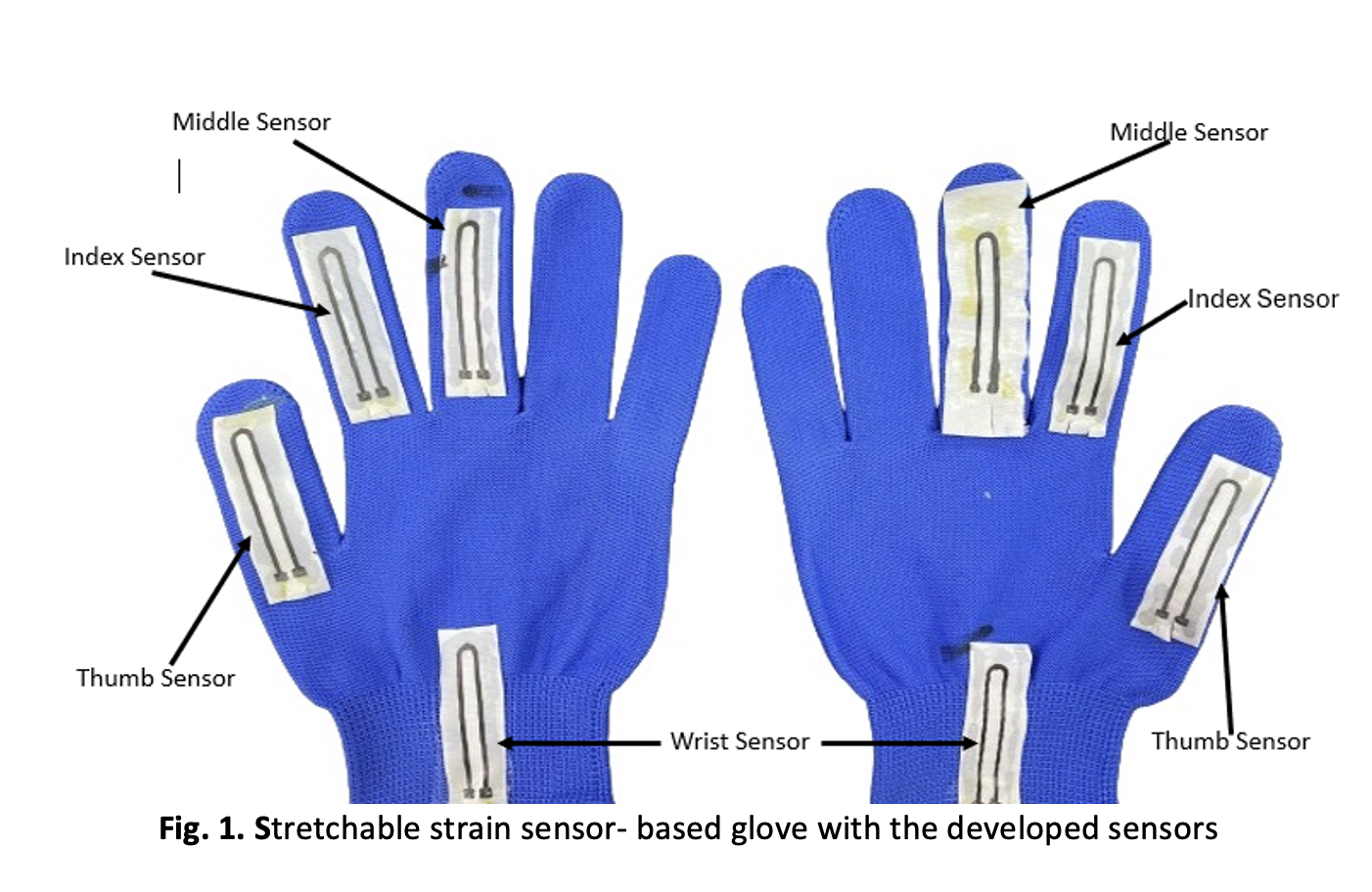
Hand movement analysis is gaining increasing attention across various fields of application. However, due to the complex dexterity and unrestricted range of motion of the human hand, developing a reliable and cost-effective method to monitor and capture hand motion remains essential. This study focuses on a stretchable sensor data glove designed to recognize hand poses during the performance of six Activities of Daily Living (ADL). The stretchable strain sensor is composed of three layers made from distinct materials, including conductive carbon ink, thermoplastic polyurethane, and a cotton/polyester fabric blend. The reliability of the strain sensor is assessed through testing, revealing mean values and standard deviations of 85kΩ ±12kΩ for the stretch stage and 25kΩ ±2.5kΩ for the relaxed stage. The developed stretchable sensors are integrated into gloves of various sizes. A custom module for reading the strain sensor data is designed using an Arduino Uno board system. A voltage divider circuit is implemented to determine the degree of finger and wrist bending, where the stretchable sensors function as unknown resistors connected in series with a 200kΩ known resistor. Twenty-three participants participate in validating the data glove’s performance, with data acquisition conducted and processed offline. Each participant performs six ADL tasks three times while wearing the data glove. Machine learning algorithms, specifically Random Forest (RF) and K-Nearest Neighbor (K-NN), are employed to classify hand poses during the six ADL tasks, achieving accuracies of 82.47% and 70.31% for RF and K-NN, respectively.