

Design of a Solar Panel with a Dual-Axis Sun Tracking System

Authors

  • Nelly Safitri Department of Electrical Engineering, Politeknik Negeri Lhokseumawe, Jl. Banda Aceh-Medan Km.280 Buketrata, Lhokseumawe, Aceh, Indonesia
  • Rudi Syahputra Department of Electrical Engineering, Politeknik Negeri Lhokseumawe, Jl. Banda Aceh-Medan Km.280 Buketrata, Lhokseumawe, Aceh, Indonesia
  • Rachmawati Rachmawati Department of Electrical Engineering, Politeknik Negeri Lhokseumawe, Jl. Banda Aceh-Medan Km.280 Buketrata, Lhokseumawe, Aceh, Indonesia
  • Suryati Suryati Department of Electrical Engineering, Politeknik Negeri Lhokseumawe, Jl. Banda Aceh-Medan Km.280 Buketrata, Lhokseumawe, Aceh, Indonesia
  • Amri Amri Department of Information and Computer Technology Engineering, Politeknik Negeri Lhokseumawe, Jl. Banda Aceh-Medan Km.280 Buketrata, Lhokseumawe, Aceh, Indonesia

DOI:

https://doi.org/10.37934/sej.13.1.144155

Keywords:

Dual-Axis Sun Tracking, LDR, Arduino Microcontroller, Servo Motor, Solar Panel System, Energy

Abstract

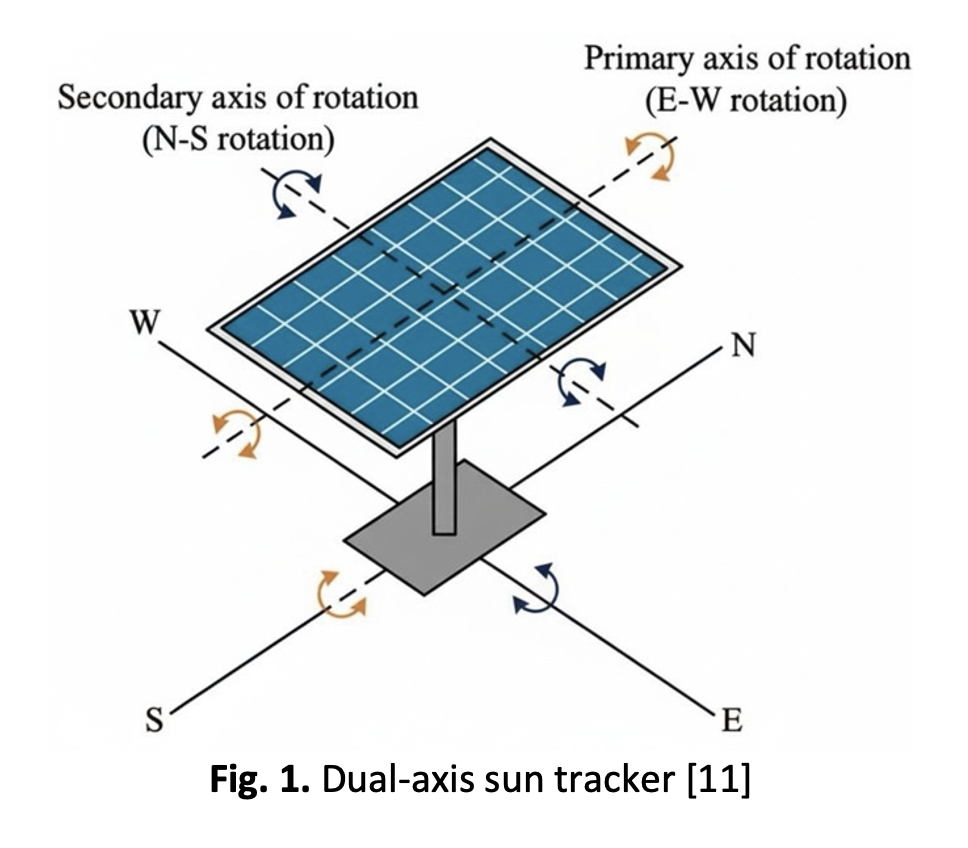
The project focuses on creating a solar panel equipped with a dual-axis sun tracking system. This innovative design allows the solar panel to follow the sun's movement throughout the day, maximizing its exposure to sunlight. By adjusting its angle both horizontally and vertically, the solar panel can capture more energy, leading to increase the efficiency. The approach taken involves a comprehensive hardware design that features a 1200Wp solar panel, light-dependent resistors (LDR) as sensors, and servo motors serving as the actuator. Complementing this hardware is a software design based on an Arduino microcontroller, which effectively processes light intensity data gathered from the sensors. To evaluate the system's performance, tests were conducted comparing the output parameters of the tracking solar panel against those of a static solar panel under typical daily sunlight conditions. The findings from the experiments indicate that the introduced dual-axis sun-tracking system enhances system efficiency by 10.27% relative to a static solar panel setup under the conditions tested. Prior research documented in the literature suggests that dual-axis tracking systems have the potential to boost energy output by around 40–50% in comparison to fixed panels, contingent upon variables such as solar radiation intensity, geographical location, and prevailing weather conditions. The LDR-based solar tracking system paired with the servo motor has demonstrated its effectiveness in boosting the power output of low-capacity solar panels as a promising solution for small scale renewable energy application.

Author Biographies

Nelly Safitri, Department of Electrical Engineering, Politeknik Negeri Lhokseumawe, Jl. Banda Aceh-Medan Km.280 Buketrata, Lhokseumawe, Aceh, Indonesia

nellysafitri@pnl.ac.id

Rudi Syahputra, Department of Electrical Engineering, Politeknik Negeri Lhokseumawe, Jl. Banda Aceh-Medan Km.280 Buketrata, Lhokseumawe, Aceh, Indonesia

rudisyahputra@pnl.ac.id

Rachmawati Rachmawati, Department of Electrical Engineering, Politeknik Negeri Lhokseumawe, Jl. Banda Aceh-Medan Km.280 Buketrata, Lhokseumawe, Aceh, Indonesia

rachmawati@pnl.ac.id

Suryati Suryati, Department of Electrical Engineering, Politeknik Negeri Lhokseumawe, Jl. Banda Aceh-Medan Km.280 Buketrata, Lhokseumawe, Aceh, Indonesia

suryati@pnl.ac.id

Amri Amri, Department of Information and Computer Technology Engineering, Politeknik Negeri Lhokseumawe, Jl. Banda Aceh-Medan Km.280 Buketrata, Lhokseumawe, Aceh, Indonesia

amri@pnl.ac.id

Downloads

Published

2026-04-03

Issue

Section

Articles