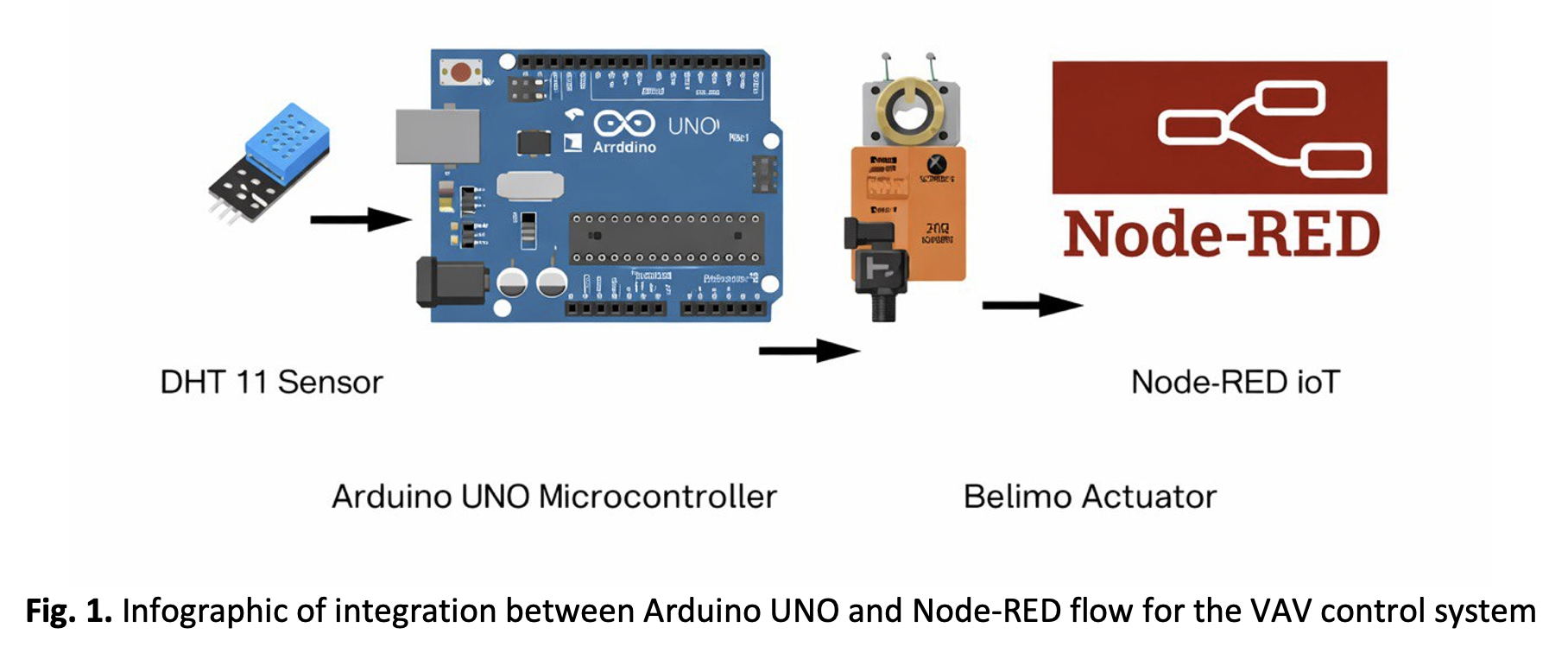


IoT-Based Real-Time Control System for Variable Air Volume (VAV) Air Conditioning Using Arduino, Temperature and Humidity Sensor, Actuators, Damper, and Node-RED

Authors

  • Hayati Mohd Abd. Ghani Faculty of Engineering Technology, Universiti Tun Hussein Onn Malaysia, Pagoh Higher Education Hub, 84600 Pagoh, Muar, Johor, Malaysia
  • Nik Normunira Mat Hassan Faculty of Mechanical Engineering, Universiti Teknologi MARA, 40450 Shah Alam, Malaysia
  • Muhamad Nazri Mohd Riffin Bakti Sekasa Sdn Bhd, Jalan Perindustrian Saujana Indah 3, Taman Perindustrian Saujana Indah, Seksyen U2, 40150 Shah Alam, Selangor, Malaysia
  • Ili Najaa Aimi Mohd Nordin Faculty of Engineering Technology, Universiti Tun Hussein Onn Malaysia, Pagoh Higher Education Hub, 84600 Pagoh, Muar, Johor, Malaysia
  • Noraini Marsi Faculty of Engineering Technology, Universiti Tun Hussein Onn Malaysia, Pagoh Higher Education Hub, 84600 Pagoh, Muar, Johor, Malaysia
  • Nurnida Elmira Othman Faculty of Mechanical Engineering, Universiti Teknologi MARA, 40450 Shah Alam, Malaysia
  • Hendro Nurhadi Department of Industrial Mechanical Engineering, Institut Teknologi Sepuluh Nopember, Kampus ITS Sukolilo, Jl. Arif Rahman Hakim, Surabaya, 60111 Surabaya Indonesia

DOI:

https://doi.org/10.37934/sej.13.1.102124

Keywords:

Direct Digital Control, Node-RED Internet of Things, Variable Air Volume

Abstract

This research is intended to develop an IoT-based real-time control system for variable air volume air conditioning. This had been built using Node-RED, which provides optimized settings based on collected data from Arduino UNO microcontrollers and DHT11 sensors. The control system targeted supply air temperature and humidity as primary controlled variables that follow the Malaysian Standard MS 1525:2014. It uses Belimo NM24A and LM230A-S actuators for damper position control, providing the system with two-position and modulating control modes. Experimental results show that good air temperature and humidity control have been achieved, with very small power and energy consumption differences between the two modes. It further provides an interface to monitor and actuate the VAV system via the Node-RED dashboard.

Author Biographies

Hayati Mohd Abd. Ghani, Faculty of Engineering Technology, Universiti Tun Hussein Onn Malaysia, Pagoh Higher Education Hub, 84600 Pagoh, Muar, Johor, Malaysia

Nik Normunira Mat Hassan, Faculty of Mechanical Engineering, Universiti Teknologi MARA, 40450 Shah Alam, Malaysia

Muhamad Nazri Mohd Riffin, Bakti Sekasa Sdn Bhd, Jalan Perindustrian Saujana Indah 3, Taman Perindustrian Saujana Indah, Seksyen U2, 40150 Shah Alam, Selangor, Malaysia

Ili Najaa Aimi Mohd Nordin, Faculty of Engineering Technology, Universiti Tun Hussein Onn Malaysia, Pagoh Higher Education Hub, 84600 Pagoh, Muar, Johor, Malaysia

ilinajaa@uthm.edu.my

Noraini Marsi, Faculty of Engineering Technology, Universiti Tun Hussein Onn Malaysia, Pagoh Higher Education Hub, 84600 Pagoh, Muar, Johor, Malaysia

Nurnida Elmira Othman, Faculty of Mechanical Engineering, Universiti Teknologi MARA, 40450 Shah Alam, Malaysia

Hendro Nurhadi, Department of Industrial Mechanical Engineering, Institut Teknologi Sepuluh Nopember, Kampus ITS Sukolilo, Jl. Arif Rahman Hakim, Surabaya, 60111 Surabaya Indonesia

Downloads

Published

2026-04-03

Issue

Section

Articles