
Advanced Damage Modelling of Primary AA6061 Aluminium Alloy Using Generalized Incremental Stress State-Dependent Damage Model (GISSMO)

Authors

  • Nor Aziera Azman Crashworthiness and Collisions Research Group (COLORED), Faculty of Mechanical and Manufacturing Engineering, Universiti Tun Hussein Onn Malaysia, Parit Raja, Johor, Malaysia
  • Liyana Syahirah Ramlan Advanced Materials and Manufacturing Centre (AMMC), Institute for Integrated Engineering (I2E), Universiti Tun Hussein Onn Malaysia, Parit Raja, Johor, Malaysia
  • Mohd Khir Mohd Nor Crashworthiness and Collisions Research Group (COLORED), Faculty of Mechanical and Manufacturing Engineering, Universiti Tun Hussein Onn Malaysia, Parit Raja, Johor, MALAYSIA
  • Mohd Syazwan Abdul Samad Material Engineering, Computer Aided Engineering, Ceer Motors, Saudi Arabia
  • Irfan Alias Farhan Latif Advanced Materials and Manufacturing Centre (AMMC), Institute for Integrated Engineering (I2E), Universiti Tun Hussein Onn Malaysia, Parit Raja, Johor, Malaysia

DOI:

https://doi.org/10.37934/sej.13.1.208233

Keywords:

Recycled Aluminium Alloy AA6061, GISSMO Fracture Mode Characterization, Uniaxial Tensile Test, Finite Element Analysis (FEA)

Abstract

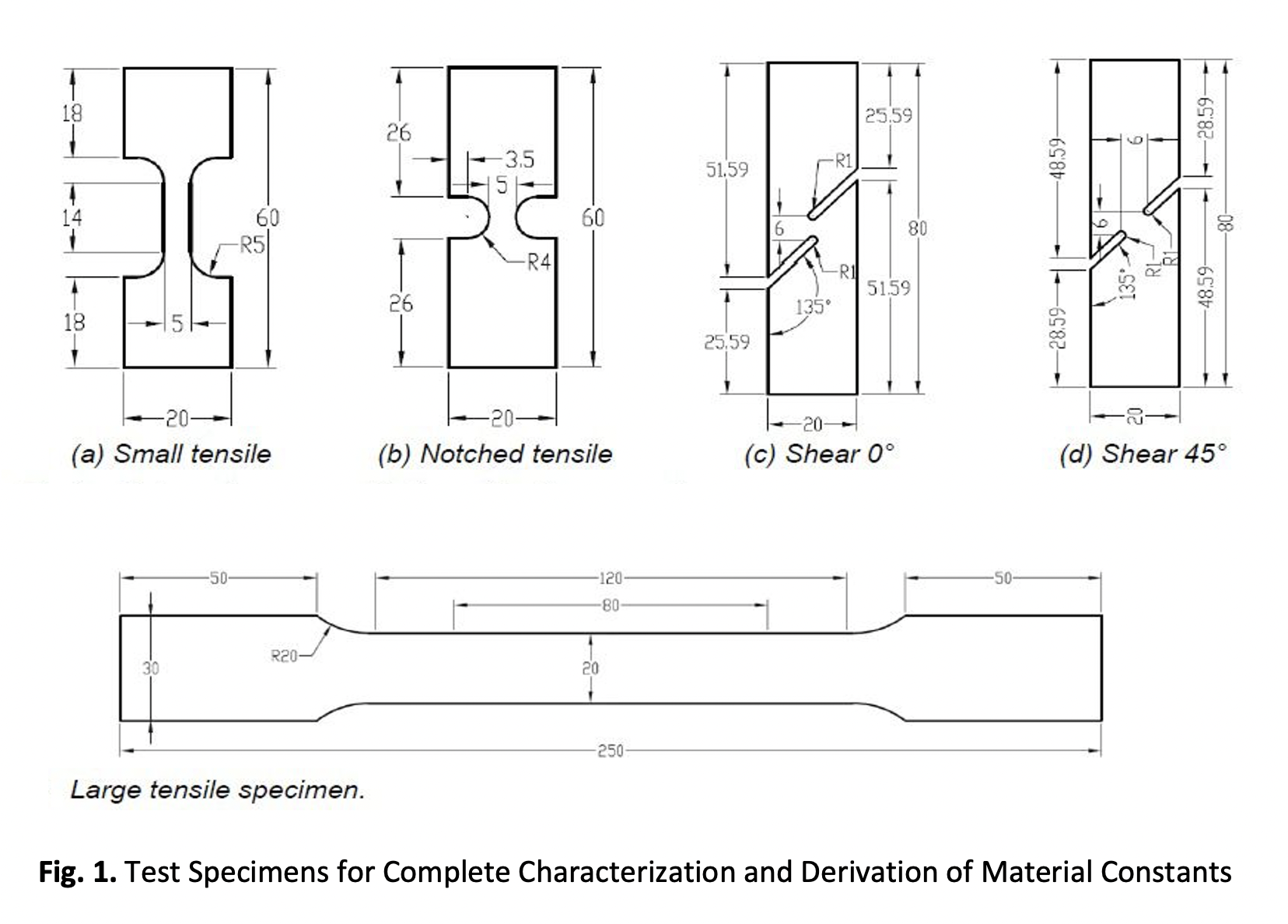
Aluminium alloy AA6061 is widely used in lightweight automotive structures due to its high strength-to-weight ratio. Accurate prediction of its deformation and fracture behaviour is critical for crashworthiness design. Therefore, this research establishes a high-fidelity fracture prediction framework for AA6061 primary aluminium alloy by implementing and validating the Generalized Incremental Stress-State Dependent Damage Model (GISSMO). To capture the complex transition between shear and tensile failure modes, five distinct specimen geometries which are smooth tensile, notched tensile, shear 0, shear 45, and large tensile that were subjected to uniaxial tensile testing across a broad spectrum of stress triaxialities. The resulting experimental data were utilized to calibrate the non-linear damage evolution and failure strain parameters within the GISSMO framework. Numerical validation was conducted via Finite Element Analysis (FEA) in Altair HyperWorks, where a rigorous comparison of force-displacement response demonstrated a high degree of correlation between the experimental and simulated curves. The comparison of simulation uniaxial tensile test force-displacement curve with experimental curve showed close agreement especially at the elastic and yield regions. Notably, the model successfully predicted the exact spatial location of fracture initiation, matching the physical rupture patterns observed in the laboratory. To ensure the integrity of the damage calibration, plasticity-only simulations were executed to isolate the material's constitutive response from damage-induced softening of Simplified Johnson-Cook model. Detailed analysis of stress and strain time histories further elucidated the localized deformation gradients within the gauge area, confirming the model's ability to track damage accumulation under heterogeneous stress states. These findings provide a robust, validated numerical tool for predicting the structural limits of AA6061, offering significant utility for high-precision engineering applications in the automotive and aerospace sectors.

Author Biography

Mohd Khir Mohd Nor, Crashworthiness and Collisions Research Group (COLORED), Faculty of Mechanical and Manufacturing Engineering, Universiti Tun Hussein Onn Malaysia, Parit Raja, Johor, MALAYSIA

Downloads

Published

2026-04-15

Issue

Section

Articles