
Optimization Using Response Surface Methodology (RSM) for production of Polyhydroxyalkanoate acid (PHA) in Chlorella Vulgaris

Authors

  • Fatin Fazira Abd Karim Department of Chemical and Environmental Engineering, Faculty of Malaysia-Japan International Institute of Technology, University Teknologi Malaysia, Jalan Sultan Yahya Petra, Kampung Datuk Keramat, 54100, Wilayah Persekutuan Kuala Lumpur, Malaysia
  • Koji Iwamoto Department of Chemical and Environmental Engineering, Faculty of Malaysia-Japan International Institute of Technology, University Teknologi Malaysia, Jalan Sultan Yahya Petra, Kampung Datuk Keramat, 54100, Wilayah Persekutuan Kuala Lumpur, Malaysia
  • Vekes Balasundram Department of Chemical and Environmental Engineering, Faculty of Malaysia-Japan International Institute of Technology, University Teknologi Malaysia, Jalan Sultan Yahya Petra, Kampung Datuk Keramat, 54100, Wilayah Persekutuan Kuala Lumpur, Malaysia
  • Shaza Eva Mohamad Department of Chemical and Environmental Engineering, Faculty of Malaysia-Japan International Institute of Technology, University Teknologi Malaysia, Jalan Sultan Yahya Petra, Kampung Datuk Keramat, 54100, Wilayah Persekutuan Kuala Lumpur, Malaysia
  • Imran Ahmad Institute for Water and Wastewater Technology, Durban University of Technology, 4001, South Africa

DOI:

https://doi.org/10.37934/sej.13.1.87101

Keywords:

Response surface methodology (RSM), Polyhydroxyalkanoate acid( PHA), Chlorella Vulgaris

Abstract

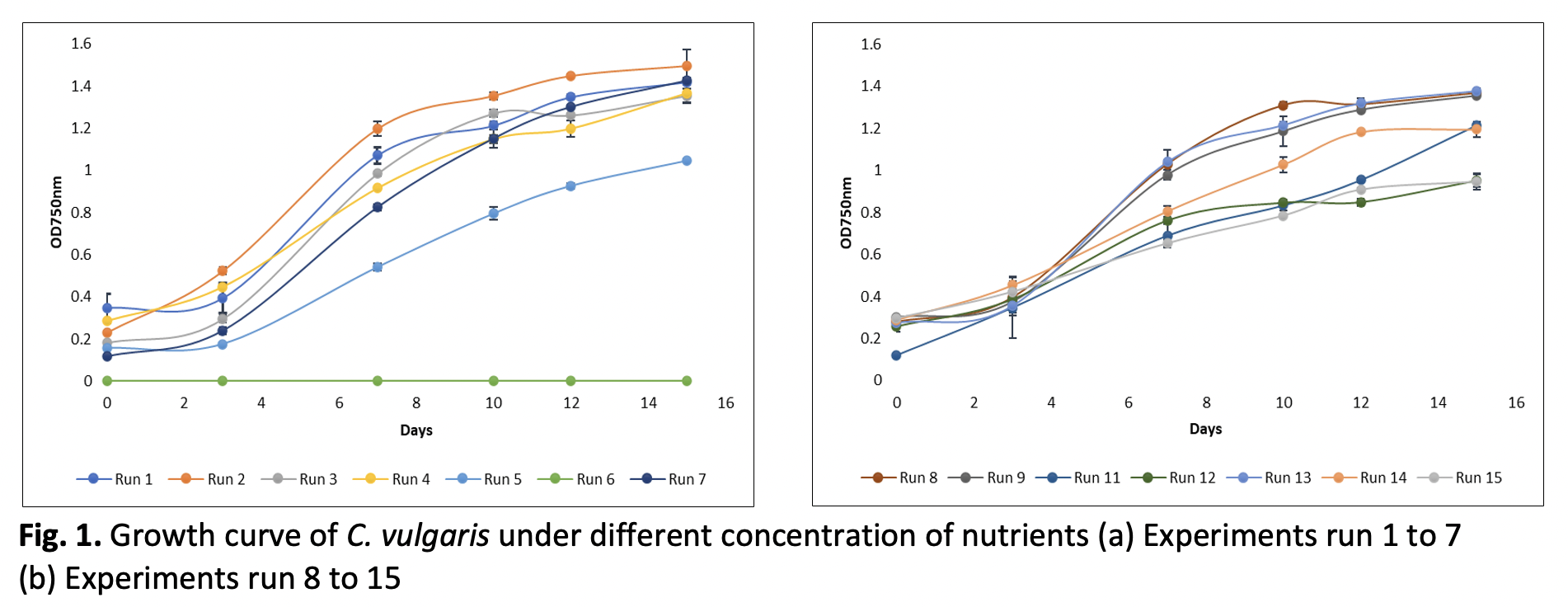
The increasing demand for sustainable and biodegradable plastics has driven interest in polyhydroxyalkanoate (PHA) produced by microorganisms. In this study, the effects of nitrogen, phosphate, and iron concentrations on PHA production by Chlorella vulgaris were investigated and optimized using response surface methodology (RSM). A Box–Behnken experimental design was employed to evaluate the influence and interaction of the selected nutrients on PHA accumulation. The results showed that nutrient availability significantly affected both microalgal growth and intracellular PHA production. The highest PHA accumulation obtained in the experimental runs was 20.28 %CDW, achieved under nitrogen-deficient conditions (0 mM nitrogen, 0.051 mM phosphate, and 0.0082 mM iron). In addition, the highest biomass productivity reached 0.0345 g L⁻¹ day⁻¹. These findings demonstrate that nutrient availability plays an important role in regulating PHA accumulation and highlight the potential of C. vulgaris as a promising microalgal source for sustainable biopolymer production.

Author Biographies

Fatin Fazira Abd Karim, Department of Chemical and Environmental Engineering, Faculty of Malaysia-Japan International Institute of Technology, University Teknologi Malaysia, Jalan Sultan Yahya Petra, Kampung Datuk Keramat, 54100, Wilayah Persekutuan Kuala Lumpur, Malaysia

faziraofficial@gmail.com

Koji Iwamoto, Department of Chemical and Environmental Engineering, Faculty of Malaysia-Japan International Institute of Technology, University Teknologi Malaysia, Jalan Sultan Yahya Petra, Kampung Datuk Keramat, 54100, Wilayah Persekutuan Kuala Lumpur, Malaysia

k.iwamoto@utm.my

Vekes Balasundram, Department of Chemical and Environmental Engineering, Faculty of Malaysia-Japan International Institute of Technology, University Teknologi Malaysia, Jalan Sultan Yahya Petra, Kampung Datuk Keramat, 54100, Wilayah Persekutuan Kuala Lumpur, Malaysia

vekes@utm.my

Shaza Eva Mohamad, Department of Chemical and Environmental Engineering, Faculty of Malaysia-Japan International Institute of Technology, University Teknologi Malaysia, Jalan Sultan Yahya Petra, Kampung Datuk Keramat, 54100, Wilayah Persekutuan Kuala Lumpur, Malaysia

shaza@utm.my

Imran Ahmad, Institute for Water and Wastewater Technology, Durban University of Technology, 4001, South Africa

mustafwibinqamar@gmail.com

Downloads

Published

2026-03-18

Issue

Section

Articles