
Utilization of Cassava Peel Waste for Biobriquette Production through Coconut Shell Charcoal Addition to Enhance Waste-to-Energy Potential

Authors

  • Gema Fitriyano Chemical Engineering Department, Engineering Faculty , Universitas Muhammadiyah Jakarta, 10510, Jakarta, Indonesia
  • Yustinah Yustinah Chemical Engineering Department, Engineering Faculty, Universitas Muhammadiyah Jakarta, 10510, Jakarta, Indonesia
  • Ummul Habibah Hasyim Chemical Engineering Department, Engineering Faculty , Universitas Muhammadiyah Jakarta, 10510, Jakarta, Indonesia
  • Tri Yuni Hendrawati Chemical Engineering Department, Engineering Faculty, Universitas Muhammadiyah Jakarta, 10510, Jakarta, Indonesia
  • Irfan Purnawan Chemical Engineering Department, Engineering Faculty , Universitas Muhammadiyah Jakarta, 10510, Jakarta, Indonesia
  • Norazwina Zainol Faculty of Chemical & Process Engineering Technology, Universiti Malaysia Pahang AlSultan Abdullah, Lebuh Persiaran Tun Khalil Yaakob, 26300 Kuantan, Pahang, Malaysia
  • Rozaimi Abu Samah Faculty of Chemical & Process Engineering Technology, Universiti Malaysia Pahang AlSultan Abdullah, Lebuh Persiaran Tun Khalil Yaakob, 26300 Kuantan, Pahang, Malaysia
  • Aisyah Rachma Hayati Chemical Engineering Department, Engineering Faculty , Universitas Muhammadiyah Jakarta, 10510, Jakarta, Indonesia
  • Annisa Mutiara Sani Chemical Engineering Department, Engineering Faculty , Universitas Muhammadiyah Jakarta, 10510, Jakarta, Indonesia

DOI:

https://doi.org/10.37934/sej.13.1.5567

Keywords:

Calorific value, cassava Peel, charcoal, coconut shell, waste-to-energy

Abstract

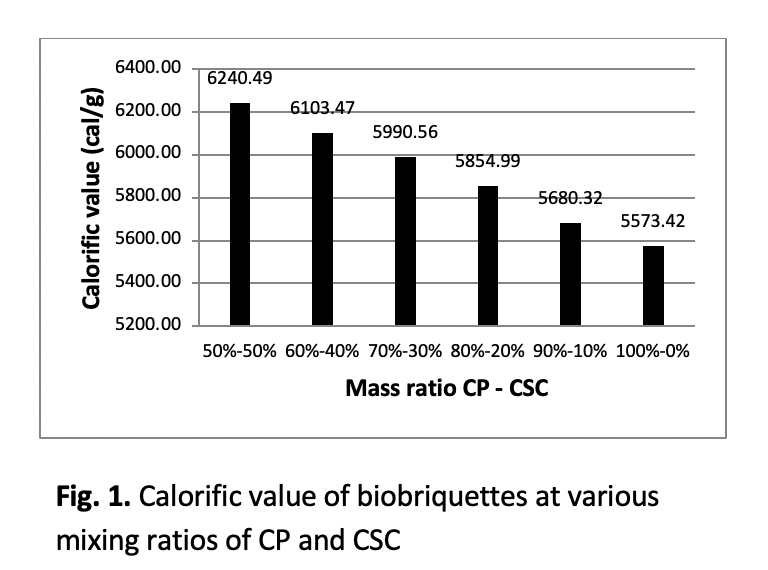
Indonesia’s growing demand for renewable energy highlights the need for practical biomass-based solutions to support the national target of achieving a 23% renewable energy share by 2025. Cassava peel waste is an abundant agricultural residue that remains underutilized despite its potential as a solid biofuel precursor. However, limited studies have systematically evaluated cassava peel charcoal as a dominant feedstock component across an extended composition range while assessing compliance with national quality standards. This study investigates the production of biobriquettes from cassava peel charcoal blended with coconut shell charcoal at five composition ratios to evaluate moisture content, ash content, volatile matter, fixed carbon, and calorific value based on Indonesian National Standard (SNI) parameters. A comparative trend analysis between lower and higher cassava peel compositions revealed observable differences in calorific value, moisture content, and ash content, whereas variations in volatile matter and fixed carbon were less pronounced within the tested range. The 50:50 cassava peel charcoal–coconut shell charcoal ratio exhibited the most balanced physicochemical profile, characterized by the highest calorific value among the evaluated formulations within the investigated composition range. These findings demonstrate the technical potential of cassava peel charcoal as a major feedstock component under laboratory-scale conditions and contribute to expanding agricultural residue utilization for renewable energy utilization within a waste-to-energy context.

Author Biographies

Gema Fitriyano, Chemical Engineering Department, Engineering Faculty , Universitas Muhammadiyah Jakarta, 10510, Jakarta, Indonesia

gema.fitriyano@umj.ac.id

Yustinah Yustinah, Chemical Engineering Department, Engineering Faculty, Universitas Muhammadiyah Jakarta, 10510, Jakarta, Indonesia

yustinah@umj.ac.id

Ummul Habibah Hasyim, Chemical Engineering Department, Engineering Faculty , Universitas Muhammadiyah Jakarta, 10510, Jakarta, Indonesia

ummul.hh@umj.ac.id

Tri Yuni Hendrawati, Chemical Engineering Department, Engineering Faculty, Universitas Muhammadiyah Jakarta, 10510, Jakarta, Indonesia

yuni.hendrawati@umj.ac.id

Irfan Purnawan, Chemical Engineering Department, Engineering Faculty , Universitas Muhammadiyah Jakarta, 10510, Jakarta, Indonesia

irfan.purnawan@umj.ac.id

Norazwina Zainol, Faculty of Chemical & Process Engineering Technology, Universiti Malaysia Pahang AlSultan Abdullah, Lebuh Persiaran Tun Khalil Yaakob, 26300 Kuantan, Pahang, Malaysia

azwina@umpsa.edu.my

Rozaimi Abu Samah, Faculty of Chemical & Process Engineering Technology, Universiti Malaysia Pahang AlSultan Abdullah, Lebuh Persiaran Tun Khalil Yaakob, 26300 Kuantan, Pahang, Malaysia

rozaimi@umpsa.edu.my

Aisyah Rachma Hayati, Chemical Engineering Department, Engineering Faculty , Universitas Muhammadiyah Jakarta, 10510, Jakarta, Indonesia

22040300015@student.umj.ac.id

Annisa Mutiara Sani, Chemical Engineering Department, Engineering Faculty , Universitas Muhammadiyah Jakarta, 10510, Jakarta, Indonesia

22040300016@student.umj.ac.id

Downloads

Published

2026-03-18

Issue

Section

Articles