Effect of Valve Opening on the Performance of a Pumping Station in a Pipeline Transportation System Using Dampers: An Experimental Study
DOI:
https://doi.org/10.37934/sej.13.1.3854Keywords:
Pumping station, pipe transportation system, dampersAbstract
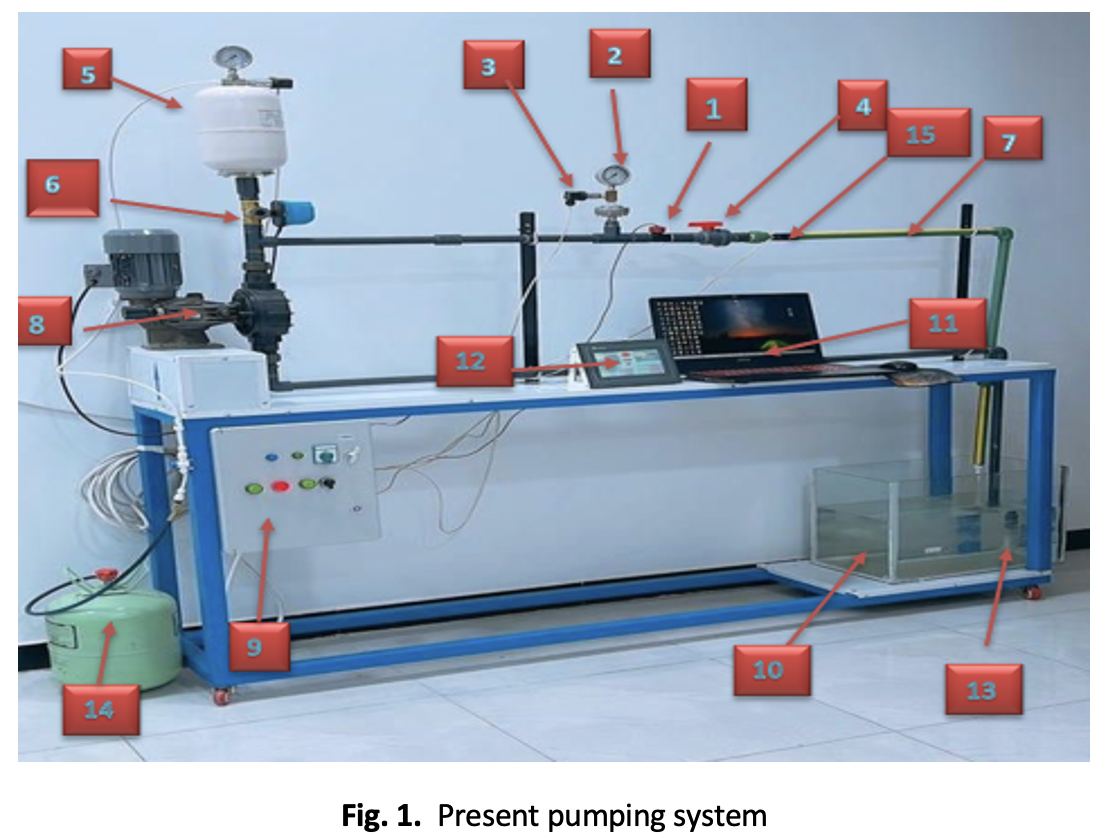
The article examines whether a choke valve opening affects the productivity of a sewerage system with dampers located in the pipe transportation line or not. The work employs a complete setup that determines the role of the valve openings in fluid flow, pressure profiles, and power consumption through experimental evaluation. The study now provides insights concerning the best possible vapor opening configurations, and damper adjustments, which, in turn, further improve the pumping station performance. Studies provide an addition to knowledge on fluid flow characteristics in fluid pipelines and suggest several recommendations on adopting proper procedures, flow rates, and acceptable pressure levels. The results of this research are a valuable contribution to the planning and regulation of safe and stable pipe systems transporting the particles. It is the pump's flow that determines what flow value the valve opening has. Leaving aside very low hydro speeds, the gate's capacity in a momentary instant change from 1.972 L/m to 6.67 L/m through the quickness of flow. The diagram of the pressure chart suggests that there is a marginal increase in the efficiency of the valve opening due to stronger flow disturbances. The stability of the pump is at its highest at speed 1: the servo-valve opening is fully open; and at speed 10, the acceleration values are 0.1297 m/s2, 0.2848 m/s2, 0.2017 m/s2, 0.1876 m/ s2, and the shaft would produce vibration with an acceleration value in the Z axis during a 10-minute test. It proves that the pump works better than the pump did before.