
Environmental Risk Management and Financial Resilience in Indian Listed Firms: Evidence from BRSR Disclosures

Authors

  • Sajit Shankar Thermochem Corporation Pvt Ltd, Bangalore, Karnataka, India
  • Rana Altounjy GlobalNxt University, Kuala Lumpur, Malaysia

Keywords:

Environmental risk management, financial resilience, BRSR, composite index, panel data, Indian listed firms, ESG governance

Abstract

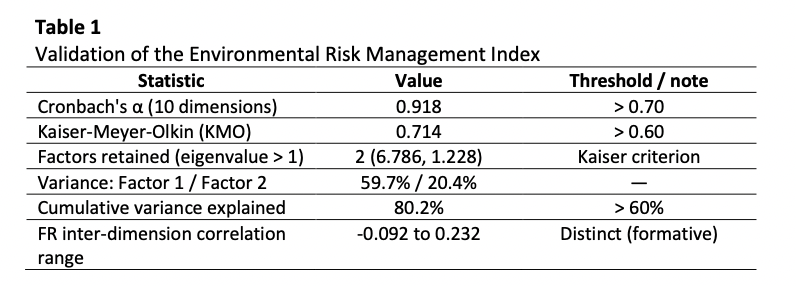
Indian capital markets have moved environmental governance from a voluntary gesture to a regulated obligation through the Securities and Exchange Board of India's Business Responsibility and Sustainability Reporting (BRSR) mandate. Whether the environmental risk management capability captured by these disclosures translates into firm financial resilience remains unclear, particularly in emerging markets, where the evidence is thin and often contradictory. This study builds two composite indices from audited disclosures: an Environmental Risk Management Index (ERMI) assembled from ten governance dimensions and a formative Financial Resilience Index (FR) covering profitability stability, liquidity, leverage resilience, and solvency. It tests whether ERMI is associated with FR across a balanced panel of 200 listed Indian firms observed over three financial years (FY2022-23 to FY2024-25, 600 firm-year observations). The ERMI showed strong internal consistency (Cronbach's α = 0.918) and a coherent two-factor structure explaining 80.2% of the variance. At the bivariate level, ERMI and FR were not positively related; once sector and firm size were controlled, the association turned positive and significant, though modest (standardized β = 0.012, p = 0.003), a sign reversal consistent with Simpson's paradox driven by sectoral composition. Two boundary conditions strengthened this relationship: operational efficiency (interaction p = 0.002) and credit rating stability (interaction p = 0.014). A model combining ERMI, the two moderators, and controls explained more variance than a controls-only baseline (ΔR² = 0.064; f² = 0.13; F(5,467) = 12.25, p < 0.001), and the effect held under a one-year lag. Environmental governance supports financial resilience in Indian firms conditionally rather than universally, and internal efficiency and external credit standing are the relevant conditions. The implications for corporate boards, investors, and BRSR disclosure policy are discussed.

Author Biographies

Sajit Shankar, Thermochem Corporation Pvt Ltd, Bangalore, Karnataka, India

sajitshankar@gmail.com

Rana Altounjy, GlobalNxt University, Kuala Lumpur, Malaysia

ra_altounjy@hotmail.com

Downloads

Published

2026-10-14

Issue

Section

Articles