
Corporate Board Diversity and Human Capital Disclosure: Evidence from Listed Manufacturing Firms in Nigeria, 2011–2025

Authors

  • Dahiru Abdulmumin Department of Accounting, Faculty of Management Sciences, Federal University of Kashere, Gombe, Nigeria
  • Muhammad Aminu Isa Department of Accounting, Bayero University Kano, Nigeria
  • Rabiu Ado Department of Accounting, Bayero University Kano, Nigeria

Keywords:

Corporate board diversity, human capital disclosure, board gender diversity, corporate governance, dynamic panel GMM, listed manufacturing firms

Abstract

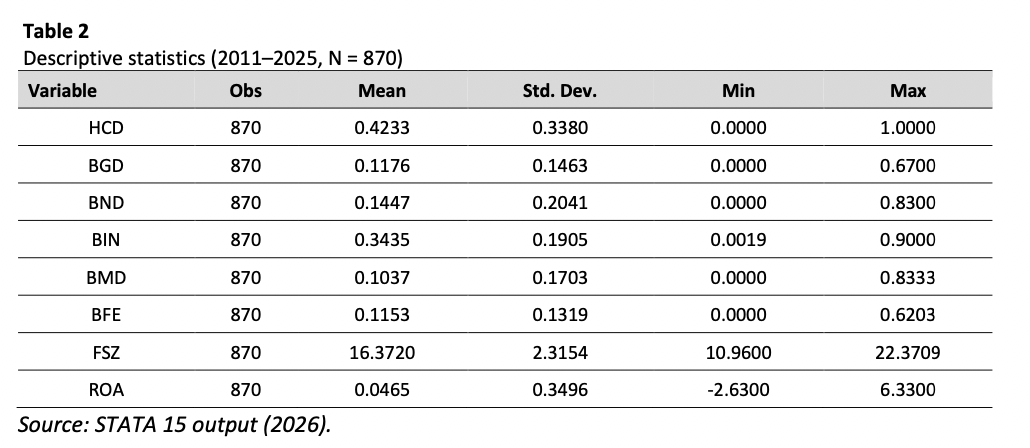
Corporate governance reforms worldwide have intensified attention on board composition and its role in improving corporate transparency. However, human capital, often regarded as one of a firm's most valuable yet least visible assets, continues to be inconsistently disclosed in corporate reporting, particularly in emerging markets. Despite increasing calls for greater workforce transparency, empirical evidence on how different board diversity attributes influence voluntary human capital disclosure remains limited and inconclusive, especially in African emerging economies such as Nigeria's manufacturing sector. This study examines the effect of corporate board diversity on human capital disclosure among listed manufacturing companies in Nigeria over fifteen years (2011–2025). The study draws on Resource-Based Theory, Stakeholder Theory, and Agency Theory to explain variations in voluntary disclosure behavior. Using a principle-based sampling procedure, the study selects a balanced panel of 58 manufacturing firms listed on the Nigerian Exchange, resulting in 870 firm-year observations. A content-analysis-based disclosure index is developed to measure the extent of human capital disclosure reported in the firms' annual reports. The study compares four candidate dynamic panel estimators through a systematic model selection procedure, leading to the adoption of the two-step system Generalized Method of Moments (GMM) estimator to address potential endogeneity and capture the dynamic nature of disclosure behavior. The findings reveal that human capital disclosure is highly persistent over time. Board gender diversity has a strong and positive effect on disclosure, whereas director independence and multiple directorships both have significant negative effects. Board nationality diversity and financial expertise demonstrate positive but statistically insignificant associations with human capital disclosure, while firm size is positively and significantly related to disclosure. Overall, the findings indicate that the relationship between board diversity and human capital disclosure is not uniformly positive. Rather, the effect depends on the specific characteristics and attributes of board members, suggesting that disclosure behavior is influenced more by underlying governance processes than by diversity alone. The study contributes novel long-term evidence from an under-researched emerging market and provides practical recommendations for regulators, corporate boards, and manufacturing firms seeking to strengthen workforce-related transparency and improve voluntary human capital disclosure.

Author Biographies

Dahiru Abdulmumin, Department of Accounting, Faculty of Management Sciences, Federal University of Kashere, Gombe, Nigeria

Muhammad Aminu Isa, Department of Accounting, Bayero University Kano, Nigeria

Rabiu Ado, Department of Accounting, Bayero University Kano, Nigeria

Downloads

Published

2026-10-09

Issue

Section

Articles