
Roles of Implementers in Successful Urban Design Policy Implementation

Authors

  • Natasha Azim Department of Landscape Architecture, Kulliyyah of Architecture & Environmental Design, International Islamic University Malaysia, Kuala Lumpur, Malaysia
  • Mohd. Ramzi Mohd. Hussain Department of Landscape Architecture, Kulliyyah of Architecture & Environmental Design, International Islamic University Malaysia, Kuala Lumpur, Malaysia

Keywords:

Urban Design Policy (UDP), Policy Implementation, Implementer Factors, Kuala Lumpur City Hall (KLCH), Urban Governance, Policy Effectiveness

Abstract

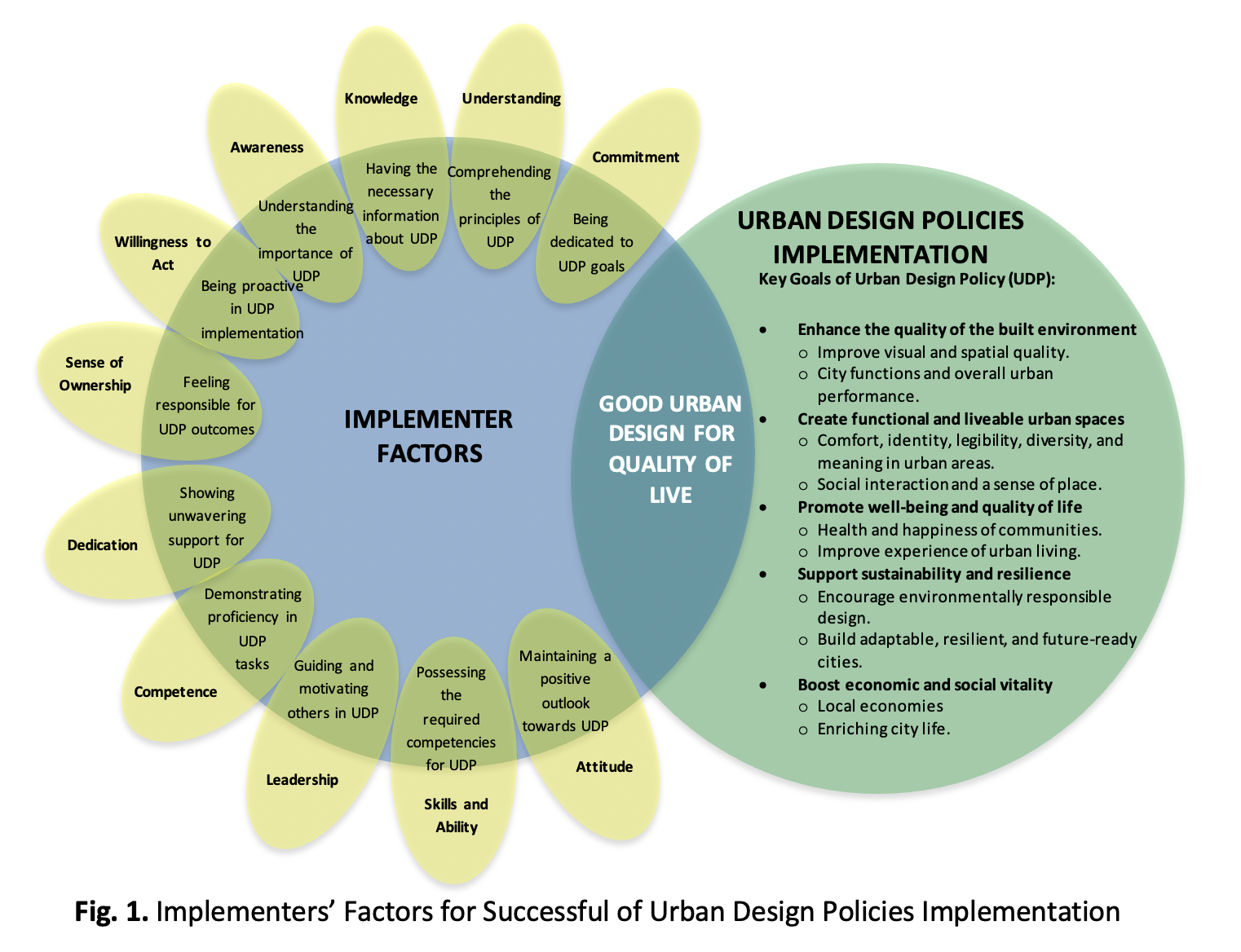
Urban Design Policies (UDPs) are essential instruments for shaping the spatial form, functionality and identity of contemporary cities. In Malaysia, particularly in Kuala Lumpur, UDPs have been introduced to enhance liveability, sustainability and city competitiveness. Despite well formulated policies such as the Kuala Lumpur Structure Plan 2020 (KLSP2020) in year 2004 and the Urban Design Guidelines for Kuala Lumpur City Centre (UDGKLCC) in year 2014, implementation outcomes remain inconsistent. This study examines the roles of implementers as a critical success factor in Urban Design Policy implementation, focusing on how their characteristics, behavior, and institutional context influence policy outcomes. The findings indicate that the success of UDP implementation depends largely on the competence, motivation and coordination of implementers rather than policy design alone. Eleven implementer-related factors were identified as critical: awareness, knowledge, understanding, commitment, attitude, skills, leadership, competence, dedication, ownership and willingness to act. Weak coordination, limited understanding and insufficient technical capacity were found to be the main barriers contributing to uneven implementation across city zones. The study highlights that implementers are the pivotal link between policy intention and practical outcomes. Strengthening their technical capability, professional commitment and organizational support is essential to enhance the effectiveness of urban design governance. By empowering implementers, local authorities such as Kuala Lumpur City Hall (KLCH) can promote policy consistency, ensure better design quality, and advance the long-term vision of a sustainable, inclusive, and livable Kuala Lumpur.

Author Biographies

Natasha Azim, Department of Landscape Architecture, Kulliyyah of Architecture & Environmental Design, International Islamic University Malaysia, Kuala Lumpur, Malaysia

nahutm@gmail.com

Mohd. Ramzi Mohd. Hussain, Department of Landscape Architecture, Kulliyyah of Architecture & Environmental Design, International Islamic University Malaysia, Kuala Lumpur, Malaysia

ramzi@iium.edu.my

Downloads

Published

2025-12-06

Issue

Section

Articles