From Global Success to Local Action: A Comprehensive Benchmarking Framework for Economically Sustainable Transit-Oriented Development
Keywords:
Transit-oriented development, urban sustainability, benchmarking framework, economic viability, sustainable transportation, urban planningAbstract
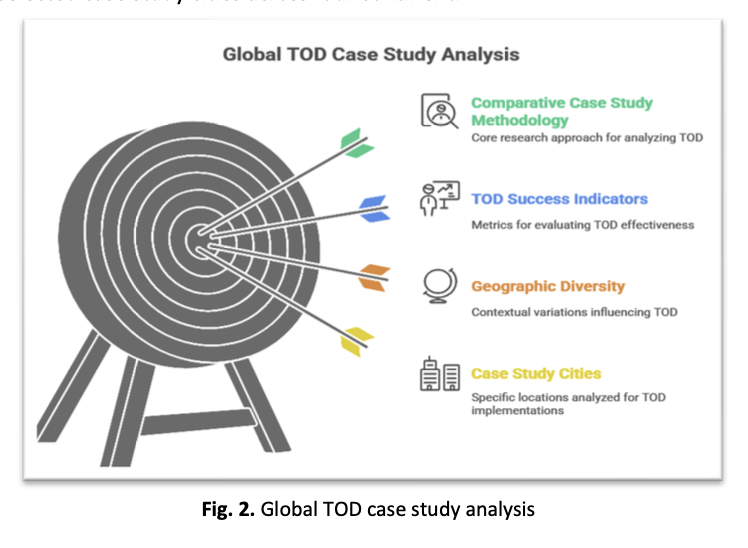
Rapid global urbanisation, with 68% of the world's population projected to live in urban areas by 2050, has intensified the need for sustainable development strategies. Transit-Oriented Development (TOD) has emerged as a promising approach to create compact, walkable communities around high-quality public transportation systems, demonstrating success across diverse global contexts. However, the absence of standardised benchmarking frameworks has hindered systematic assessment and improvement of TOD initiatives worldwide. Cities struggle to translate global success stories into locally actionable strategies, particularly regarding economic sustainability assessment, which remains the paramount concern for long-term project viability and stakeholder investment decisions. This research aims to develop a comprehensive benchmarking framework that bridges the gap between global TOD success and local implementation realities, enabling cities to optimize their transit-oriented initiatives through evidence-based assessment tools. A comparative case study methodology systematically analysed eleven globally recognised successful TOD cities across four continents: North America, Latin America, Europe, Asia, and Australia. Through a comprehensive review of academic literature, government reports, and planning documents, a matrix evaluation framework assessed twenty-two distinct TOD strategies across all case studies, combining quantitative pattern analysis with qualitative contextual examination. The analysis identified six universal critical success factors implemented across all successful cities: integrated land-use and transportation planning control, high-density development optimisation, mixed-use development around transit-nodes, comprehensive zoning and planning control, extensive pedestrian and cycling infrastructure, and systematic community engagement. Economic sustainability indicators emerged as the primary driver, with leading cities demonstrating property value premiums reaching 28%, infrastructure cost reductions of 25%, and substantial revenue generation through land value capture mechanisms. The resulting benchmarking framework transforms global insights into local action through six weighted assessment dimensions, providing standardised assessment criteria while maintaining flexibility for local adaptation. This framework enables cities worldwide to systematically evaluate their TOD performance, identify improvement priorities, and implement evidence-based enhancement strategies, ultimately contributing to more economically viable and sustainable urban development globally.