Recovering Attention with Restorative Environment Against Driving Fatigue at Expressway Service Areas: A Scoping Review
Keywords:
Attention restoration, restorativeness, motorway service area, highway service area, driving fatigue, fatigue recoveryAbstract
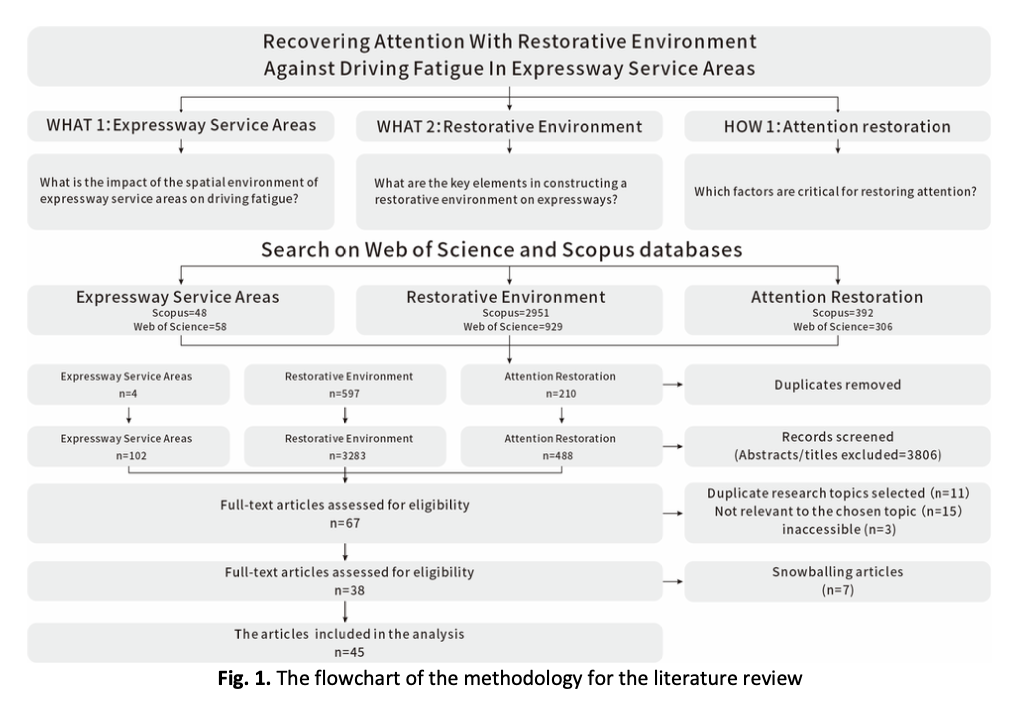
Prolonged driving on expressways can induce fatigue and lapses of attention, undermining road safety. Because expressway service areas are key sites for driver recovery, there is a pressing need for design guidance that effectively mitigates fatigue and restores attention. This study aims to develop a theoretical framework for restorative service area environments. We conducted an extensive review of the peer-reviewed literature by searching Web of Science and Scopus, screening records against predefined criteria, and closely analyzing 45 eligible studies. The synthesis addressed three guiding questions: 1. What is the impact of the spatial environment of expressway service areas on driving fatigue? 2. What are the key characteristics in constructing a restorative environment at expressway service areas? 3. Which factors are critical for restoring attention? Across the 45 studies, we consolidated recurrent evidence into a three-stage framework for practice: co-defining environmental indicators with users and experts; assessing perceptions to identify attention restoring characteristics; and validating design interventions through empirical evaluation. The review also maps typical constructs used to capture restoration (e.g., perceived restorativeness and attention outcomes) and highlights commonly examined environmental features and assessment approaches. Overall, the principal result is an integrative framework that links environmental indicators, perceptual responses, and evaluation pathways to guide the design and appraisal of restorative service areas. We conclude that applying this framework can standardize indicator selection, sharpen measurement of attention-related outcomes, and support evidence-based upgrades of expressway service areas. These contributions provide a theoretical foundation for subsequent research and offer actionable direction for practitioners seeking to enhance drivers’ recovery during breaks.