Solar Powered Automatic Fish Feeder Integrated with Dissolved Oxygen Sensor for Precision Aquaponics
Keywords:
Aquaponics, Dissolved Oxygen Sensor, Precision Agriculture, Renewable Energy, Solar-Powered Fish FeederAbstract
The global population growth, projected to reach 10 billion by 2050, increasingly threatens the world's food security crisis. Currently, conventional agriculture consumes 70% of the world's freshwater resources, which is why aquaponics has emerged as an efficient closed-loop farming solution for integrating hydroponic aquaculture. However, operational challenges arise from the accumulation of uneaten feed that isn’t properly managed. This triggers ammonia toxicity through nitrification by Nitrosomonas and Nitrobacter bacteria, and causes rapid fluctuations in Dissolved Oxygen (DO) levels, which poses a high risk of fatal hypoxia stress for fish. To tackle these challenges, this study aims to implement the development of a solar-powered automatic fish feeder system integrated with real-time DO sensors based on IoT to achieve precision aquaponics. In addition, applying smart algorithms with an IoT system can optimize autonomous feeding policies, minimize leftover feed accumulation, prevent toxic ammonia spikes, and ultimately significantly improve feed conversion ratios. Data collection was done by selecting and analyzing scientific articles from various academic publications focusing on aquaponic system efficiency, IoT control automation, water quality, and renewable energy management. The use of hybrid solar energy combined with artificial intelligence has proven capable of maximizing efficiency through load shifting. Therefore, integrating IoT and solar energy will boost smart aquaponic responses and support the principles of a circular bioeconomy for sustainable clean energy .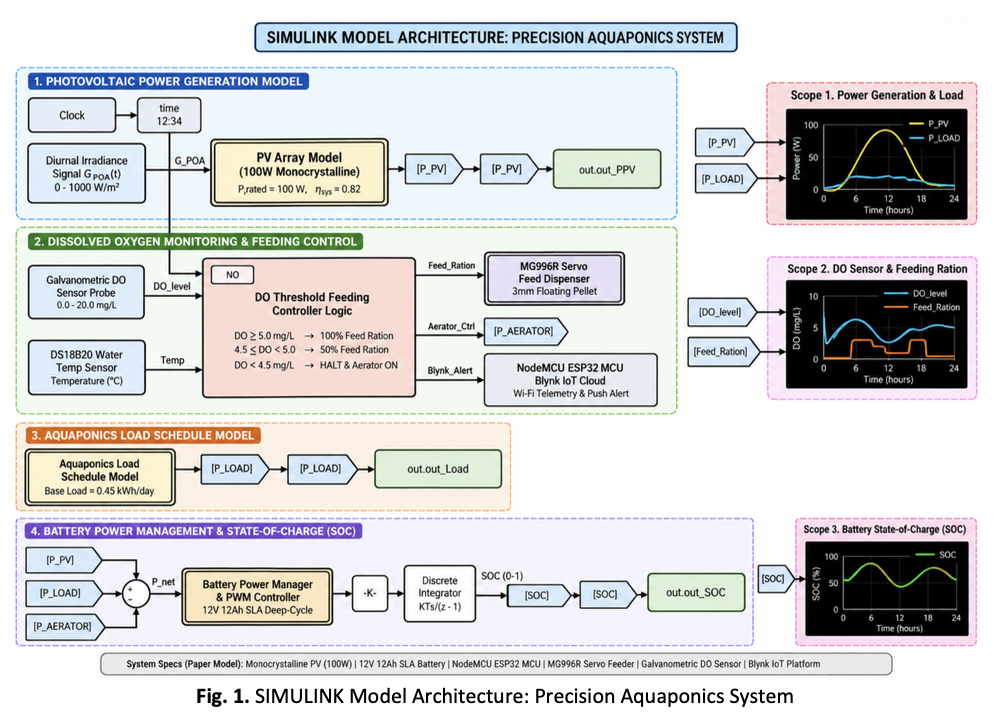
Downloads
Published
2026-11-05
How to Cite
Kholidatul Aliyah Safitri, Muhammad Farrel Caesar, Loudy Firza Aulia, Maritza Aprillia Putri, M.Salman Alfarizi Ramadani, Singgih Dwi Prasetyo, & Nadiya Ayu Astarini. (2026). Solar Powered Automatic Fish Feeder Integrated with Dissolved Oxygen Sensor for Precision Aquaponics. Semarak International Journal of Animal Sciences and Zoology, 7(1), 1–8. Retrieved from http://semarakilmu.my/index.php/sijasz/article/view/1256
Issue
Section
Articles