Numerical Analysis of Flow Characteristics in Axial Fans using the ANSYS Fluent-Based Computational Fluid Dynamics (CFD) Method

Authors

  • Thufail Adji Nugroho Power Plant Engineering Technology, Faculty of Vocational Studies, State University of Malang, 65145 Malang, Indonesia
  • Nur Wilda Power Plant Engineering Technology, Faculty of Vocational Studies, State University of Malang, 65145 Malang, Indonesia
  • Tri Fajar Candra Bagaskara Power Plant Engineering Technology, Faculty of Vocational Studies, State University of Malang, 65145 Malang, Indonesia
  • Nur Hidayatullah Dafana Power Plant Engineering Technology, Faculty of Vocational Studies, State University of Malang, 65145 Malang, Indonesia
  • Rama Reynanda Alif Wianto Power Plant Engineering Technology, Faculty of Vocational Studies, State University of Malang, 65145 Malang, Indonesia
  • Billy Bintang Jatmiko Power Plant Engineering Technology, Faculty of Vocational Studies, State University of Malang, 65145 Malang, Indonesia
  • Olivia Susanto Power Plant Engineering Technology, Faculty of Vocational Studies, State University of Malang, 65145 Malang, Indonesia
  • Sheila Reinanda Putri Power Plant Engineering Technology, Faculty of Vocational Studies, State University of Malang, 65145 Malang, Indonesia
  • Singgih Dwi Prasetyo Power Plant Engineering Technology, Faculty of Vocational Studies, State University of Malang, 65145 Malang, Indonesia

Keywords:

Axial fan, CFD simulation

Abstract

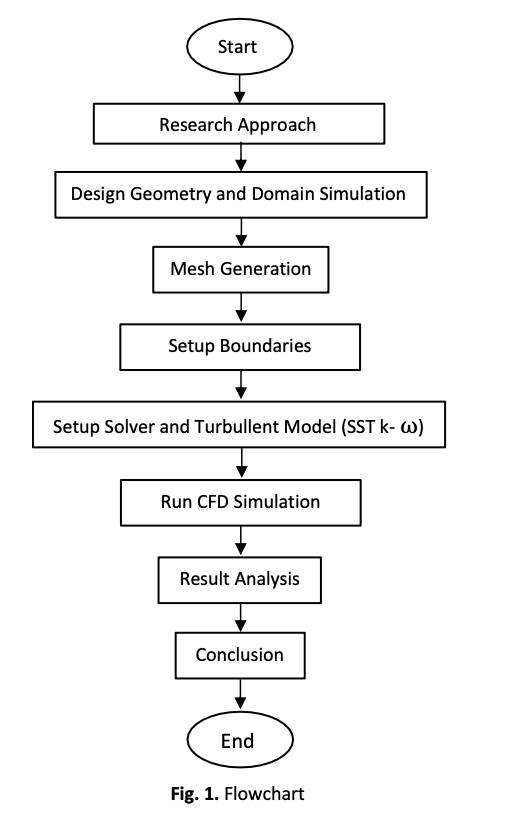
Axial fans play an important role in ventilation and cooling systems, where aerodynamic efficiency greatly determines overall performance. This study aims to provide new insights into the distribution of velocity and pressure around the rotor-stator configuration of axial fans, as well as its implications for energy conversion efficiency. Simulations were performed using the ANSYS Fluent-based Computational Fluid Dynamics (CFD) method with a k–ω Shear Stress Transport (SST) turbulence model under steady-state conditions. The simulation results showed significant flow acceleration at the blade tips, which contributed to pressure recovery in the stator region, with a pressure difference of approximately 23.7 kPa between the suction side and the pressure side. The identified flow pattern shows the role of the stator in straightening the flow and reducing residual vortices, which directly implies an increase in the aerodynamic efficiency of the system.Although the results show qualitative agreement with the literature trends, the mass imbalance and residual values that have not fully converged indicate the need to improve the mesh configuration and iteration scheme to obtain more accurate results. These findings provide insights into the relationship between blade design, pressure distribution, and flow efficiency, which can serve as a basis for optimizing industrial axial fan designs.
Author Biographies

Thufail Adji Nugroho, Power Plant Engineering Technology, Faculty of Vocational Studies, State University of Malang, 65145 Malang, Indonesia

thufail.adji.2409347@students.um.ac.id

Nur Wilda, Power Plant Engineering Technology, Faculty of Vocational Studies, State University of Malang, 65145 Malang, Indonesia

nur.wilda.2409347@students.um.ac.id

Tri Fajar Candra Bagaskara, Power Plant Engineering Technology, Faculty of Vocational Studies, State University of Malang, 65145 Malang, Indonesia

tri.fajar.2409347@students.um.ac.id

Nur Hidayatullah Dafana, Power Plant Engineering Technology, Faculty of Vocational Studies, State University of Malang, 65145 Malang, Indonesia

nur.hidayatullah.2409347@students.um.ac.id

Rama Reynanda Alif Wianto, Power Plant Engineering Technology, Faculty of Vocational Studies, State University of Malang, 65145 Malang, Indonesia

rama.reynanda.2409347@students.um.ac.id

Billy Bintang Jatmiko, Power Plant Engineering Technology, Faculty of Vocational Studies, State University of Malang, 65145 Malang, Indonesia

billy.bintang.2409347@students.um.ac.id

Olivia Susanto, Power Plant Engineering Technology, Faculty of Vocational Studies, State University of Malang, 65145 Malang, Indonesia

olivia.susanto.2409347@students.um.ac.id

Sheila Reinanda Putri, Power Plant Engineering Technology, Faculty of Vocational Studies, State University of Malang, 65145 Malang, Indonesia

sheila.reinanda.2409347@students.um.ac.id

Singgih Dwi Prasetyo, Power Plant Engineering Technology, Faculty of Vocational Studies, State University of Malang, 65145 Malang, Indonesia

singgih.prasetyo.fv@um.ac.id

Downloads

Published

2025-11-05

Issue

Section

Articles