
Influence of [EMIM][OOF] Ionic Liquid on the electrical and Structural Properties of Gel Polymer Electrolytes

Authors

  • Norshahirah Mohamad Saidi Department of Physics, Faculty of Science, Universiti Teknologi Malaysia, 81310 Skudai, Johor, Malaysia
  • Nurhafizah Hasim Department of Physics, Faculty of Science, Universiti Teknologi Malaysia, 81310 Skudai, Johor, Malaysia
  • Nur Hidayah Ahmad Department of Physics, Faculty of Science, Universiti Teknologi Malaysia, 81310 Skudai, Johor, Malaysia
  • Chetna Tyagi Department of Applied Sciences, The NorthCap University, Gurugram 122017, India
  • Suresh Thanakodi Department of Science and Maritime Technology, Faculty of Science and Defence Technology, Universiti Pertahanan Nasional Malaysia, 57000 Kuala Lumpur, Malaysia

Keywords:

Ionic liquid, Gel polymer electrolyte, Electrochemical impedance spectroscopy, Ionic conductivity

Abstract

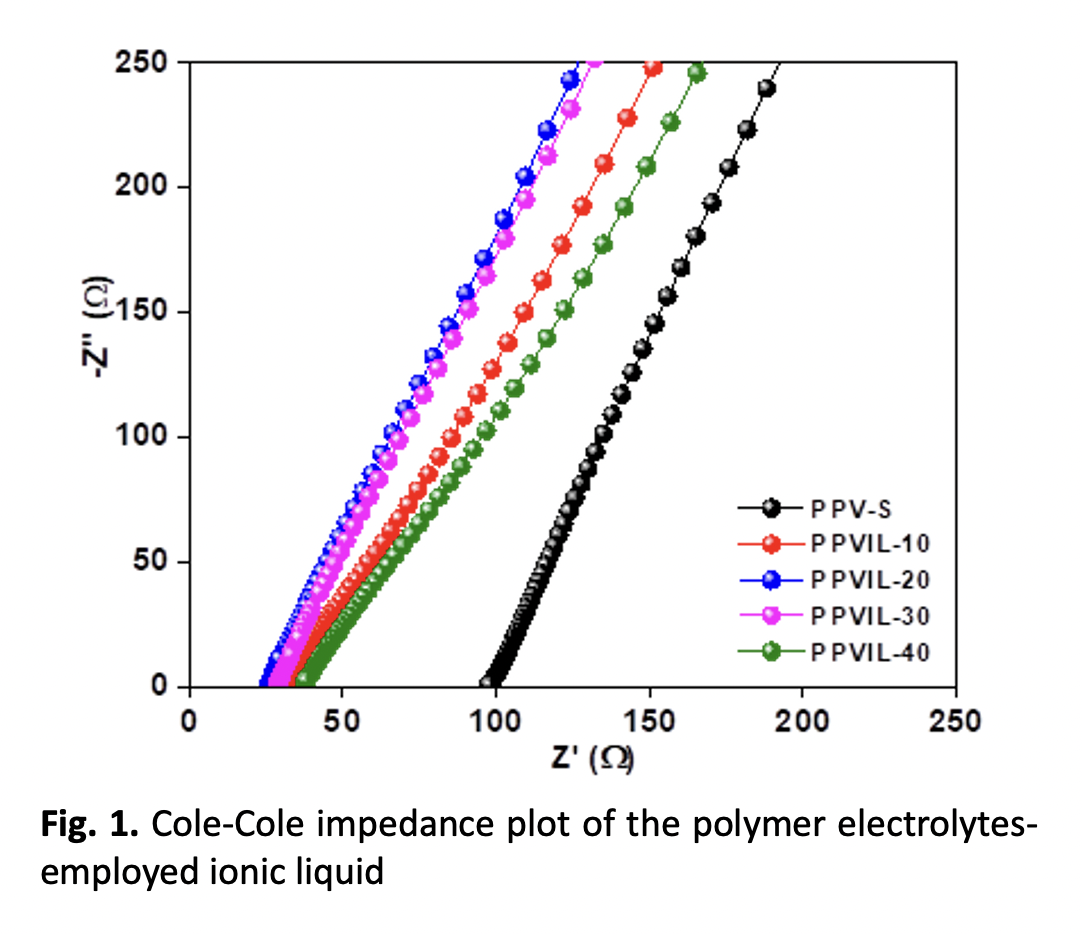
The growing demand for sustainable and efficient energy storage devices underscores the urgent need for safer and higher-performing electrolytes. Conventional liquid electrolytes offer high ionic conductivity but pose safety and leakage risks, while solid polymer electrolytes often suffer from limited ion mobility and poor interfacial contact. To overcome these limitations, this study investigates the effect of incorporating the ionic liquid 1-ethyl-3-methylimidazolium trifluoromethanesulfonate ([EMIM][OTf]) into a gel polymer electrolyte based on poly(1-vinylpyrrolidone-co-vinyl acetate) [P(VP-co-VAc)]. The objective of this work is to examine how varying the ionic liquid content influences the electrical and structural properties of the electrolyte. By optimizing the composition, a maximum ionic conductivity of 4.92 ×10⁻³ S/cm was achieved at 20 wt.% [EMIM][OTf]. X-ray diffraction analysis revealed that the improved conductivity is associated with reduced crystallinity, which facilitates ion transport. This study offers new insights into the role of [EMIM][OTf] in enhancing the amorphous character and ion mobility of P(VP-co-VAc)-based electrolytes, thereby contributing to the design of safer and more efficient gel polymer electrolytes for advanced energy storage applications.

Author Biographies

Norshahirah Mohamad Saidi, Department of Physics, Faculty of Science, Universiti Teknologi Malaysia, 81310 Skudai, Johor, Malaysia

norshahirah.ms@utm.my

Nurhafizah Hasim, Department of Physics, Faculty of Science, Universiti Teknologi Malaysia, 81310 Skudai, Johor, Malaysia

nurhafizah.h@utm.my

Nur Hidayah Ahmad, Department of Physics, Faculty of Science, Universiti Teknologi Malaysia, 81310 Skudai, Johor, Malaysia

nurhidayahahmad@utm.my

Chetna Tyagi, Department of Applied Sciences, The NorthCap University, Gurugram 122017, India

chetnatyagi@ncuindia.edu

Suresh Thanakodi, Department of Science and Maritime Technology, Faculty of Science and Defence Technology, Universiti Pertahanan Nasional Malaysia, 57000 Kuala Lumpur, Malaysia

suresh@upnm.edu.my

Downloads

Published

2025-10-30

Issue

Section

Articles